James Robert Betts was born on 17 September 1931, in Marion, Ohio. His parents are James Betts & Lula (Coon) Gullett. He was married to Gillie G. (Ferris), in Indiana, on 29 December 1951.
James R. Betts attained the rank of Sergeant (Sgt.). He served in Korea with the 630th Engineer Light Equipment Company, 19th Engineer Construction Group. Sgt. James Betts served as a construction equipment operator. While operating a bulldozer a can of gasoline exploded. Sgt. Betts received severe burns to his body and respiratory tract. He was taken for treatment to the 11th Evacuation Hospital. Sgt. James R. Betts died from his injuries on 29 September 1953.
Sgt. James R. Betts was awarded: the Korean Service Medal, the United Nations Service Medal, the National Defense Service Medal, the Korean Presidential Unit Citation and the Republic of Korea War Service Medal.
Sgt. James R. Betts is buried in the C M Cemetery, Oak Hill, Jackson County, Ohio.
James R. Betts’ name is not found on any Honor Rolls in Marion County.
At the time of our meeting and interview, Ms. Fate was not doing well. She had just been placed on Hospice and wanted to share about her military service. She was found to be very proud of her service to her country. She also related that she was “the only ‘girl’ member of the local Korean War Veterans Association.” The following is what she wanted to share.
Phyllis M. (Barber) Fate was born in Portland, Oregon, in 1922. Phyllis said that she was born in the family home, in Portland. Her parents are Frank & Rebecca Barber. She has a sister, Beverly (Barber) Steele. Her sister also served in the Navy, as a WAVE Phyllis attended High School at Gresham Union High School, in Oregon. She graduated from Gresham High School in 1948.
After high school she decided to join the United States Navy, in the W. A. V. E. S. program. She said her parents had no problem with her joining. Her parents felt she was an adult and could make her own decisions. Her sister was already signed up and serving in the military too. She said she never served at the same stations as her sister. Her sister served her time in Boston.
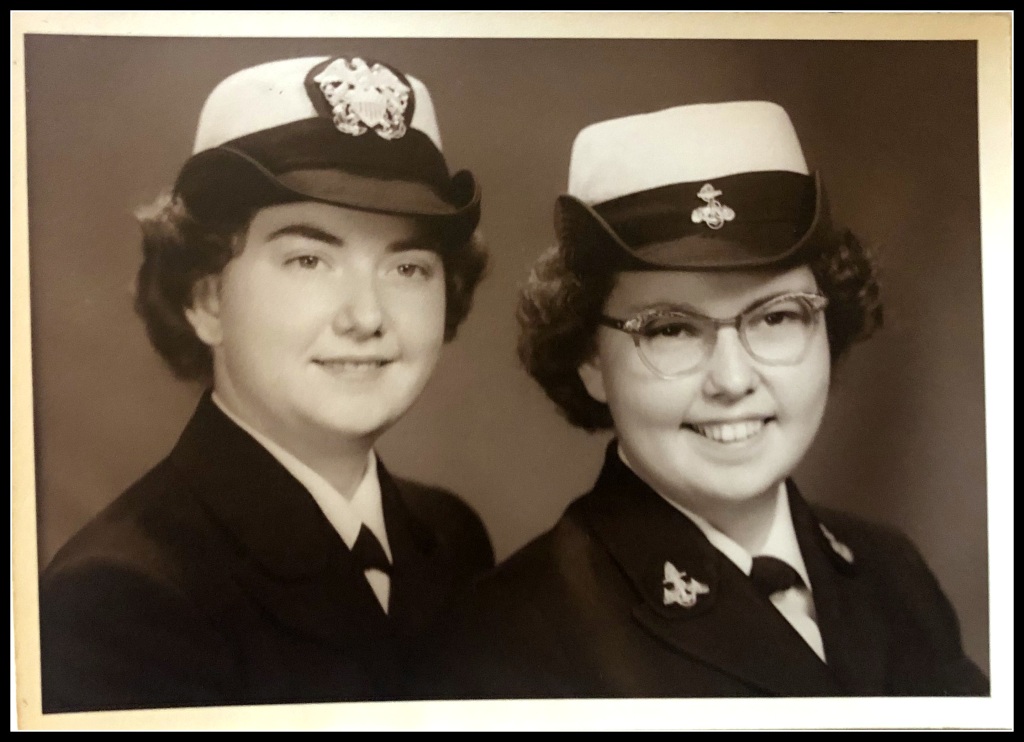
Lt. Phyllis Barber (left) and sister, Beverly (right)
Phyllis joined the United States Navy in 1952. She served for almost 7 years. During that time she was stationed at Long Island, New York for Basic Training; and was later sent to California to work aboard the U. S. S. Haven (AG-12). The Haven was a hospital ship. It had served during the Korean War to receive treat and transport casualties from the war. The Haven was later placed in dry dock in California. There it still functioned as a hospital ship for the military.
While Lt. Phyllis Barber was serving she said she wrote often to her mother and aunt. She said that she stayed busy in her free time by sewing with a sewing group she belonged to. She also remembers a time when her and some friends went to see a movie that was in production, while in San Diego, California.
Phyllis received her training as a Registered Nurse at the Lewis and Clark College in Portland, Oregon. Phyllis attained the Rank of Lieutenant (j.g.). She also met her husband, William Fate, while she was serving. William Fate is a native of Marion, Ohio. William is a veteran of World War Two, the Korean War and the Vietnam War.
Phyllis said she also served in Washington, Wisconsin, in a receiving station for new recruits. Here she assisted in medical exams of new recruits. She also spent time at Camp Lejeune, North Carolina.
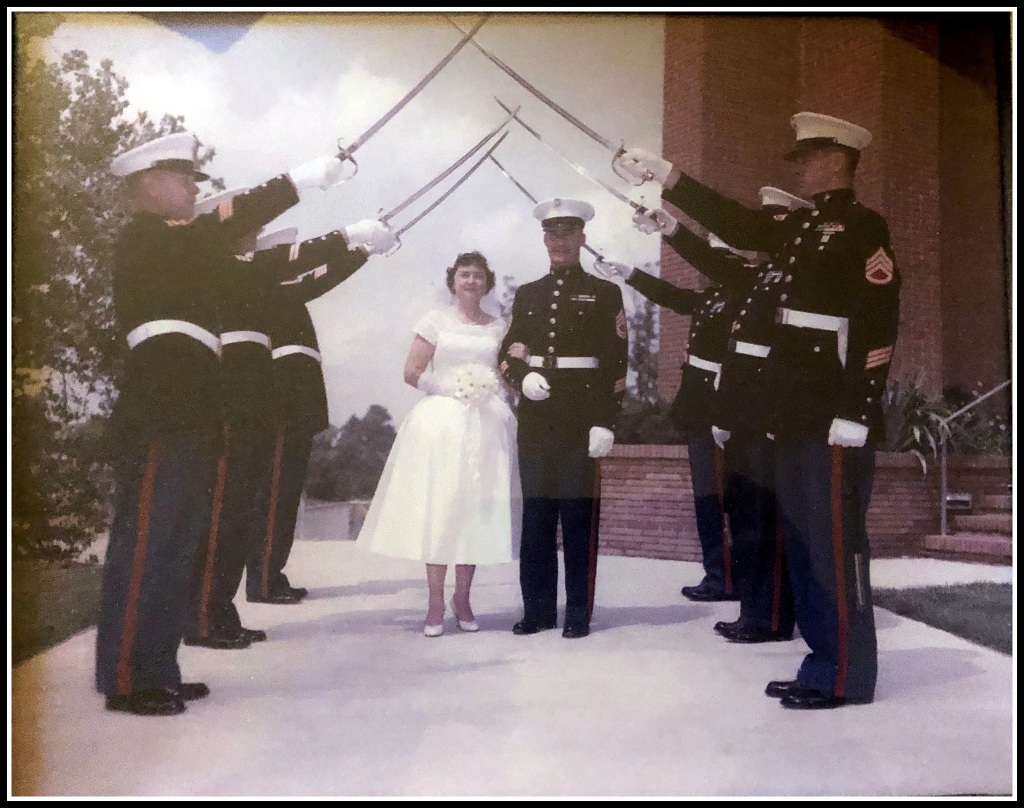
William & Phyllis Fate on their wedding day
When Phyllis met her husband, who was in the Marine Corps., she was an officer and he was an NCO. She said since they were not in the same chain-of-command, so the military did not frown upon their relationship. But when she became pregnant, she had to leave service, as the WAVES did not permit them to have dependents.
When her husband, William, retired from the Marine Corps., they relocated to his hometown of Marion, Ohio. William had served for 30 years in the United States Marine Corps. He saw service through World War One, the Korean War and the Vietnam War.
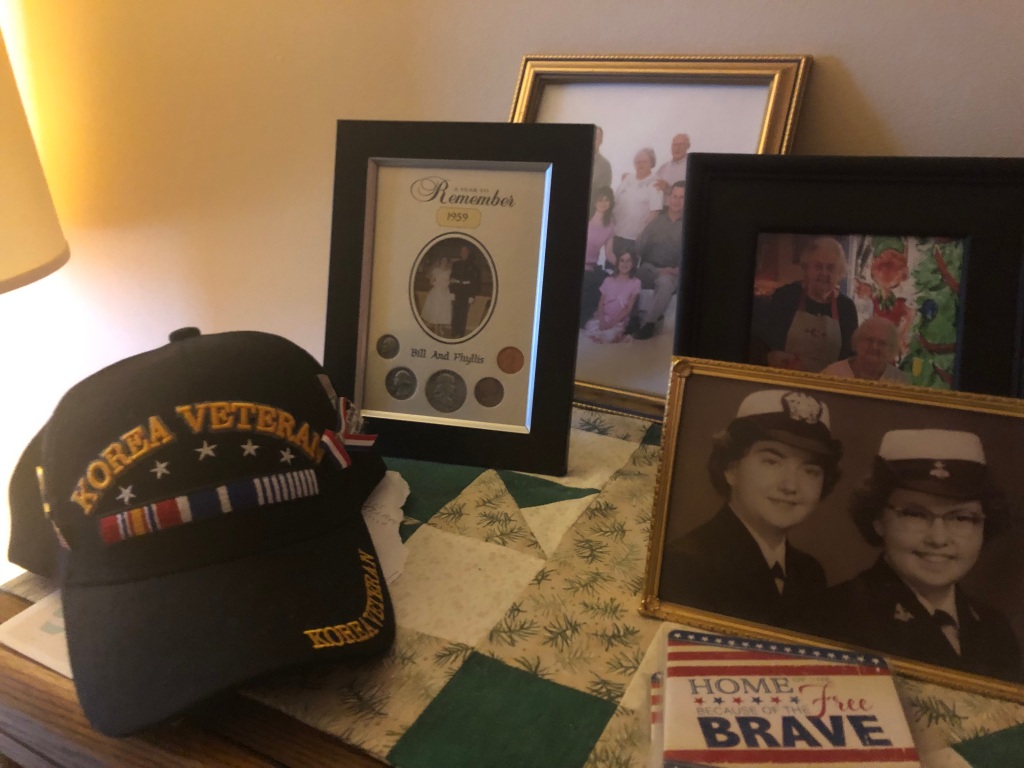
Phyllis and William were married and raised two sons, William and David, in Marion, Ohio. One son also served as a Marine. When Phyllis came to Marion to set up her home, she worked at the Marion Power Shovel on the Shovel’s weekly newspaper. She then returned to nursing at Marion General Hospital as a medical floor nurse, where she retired. Phyllis calls Marion her home. Here she raised her two sons and worked until retirement. Phyllis is very proud to have served her country and still displays here photos from the days she was a Navy Lieutenant.
William Earl Fultz was born 29 June 1933, in Shawnee, Oklahoma. He married Charlene Dewitt. Fultz was a resident of Marion, Ohio.
William E. Fultz was a career Army service member. He had entered service about 19-1/2 years prior to his accidental death. Fultz had attained the rank of Staff Sergeant (SSgt). SSgt. Fultz was a veteran of both Korea and Vietnam.
While heading home for Christmas in 1971, he was involved in an automobile accident in Indiana. He was coming home from Fort Sheridan, Illinois. SSgt. Fultz died as a result of this accident on 15 December 1971.
SSgt. William E. Fultz left behind his wife and daughter, Kathryn L. Fultz. Kathryn who was born in Columbia, South Carolina, stayed in Marion, Ohio, and raised her family here. She had married Roger Rayburn. SSgt. William E. Fultz is remembered on Honor Roll at the Veterans Memorial Park in Marion, Ohio.
Frank Edward Townsend was born on 17 April 1921, in Marion County, Ohio. His parents are Frank E. & Virtie I. (Sharp) Townsend. On 28 October 1942, he married Dorothy (Lyon).
Frank E. Townsend entered service on 6 March 1940. He attended naval training at Newport Rhode Island. Townsend served in the United States Navy during World War Two and the Korean War. During World War Two, he saw service aboard the U. S. S. Mackenzie (DD-175), U. S. S. Gregory (APD-3), U. S. S. William Ward Burrows (AP-6), U. S. S. Stevens (DD-479) and the U. S. S. Cassin Young (DD-793).
On 24 May 1940, Townsend was assigned to the U. S. S. Mackenzie (DD-175). From 25 August to 17 September 1940, Townsend saw service with the British Navy.
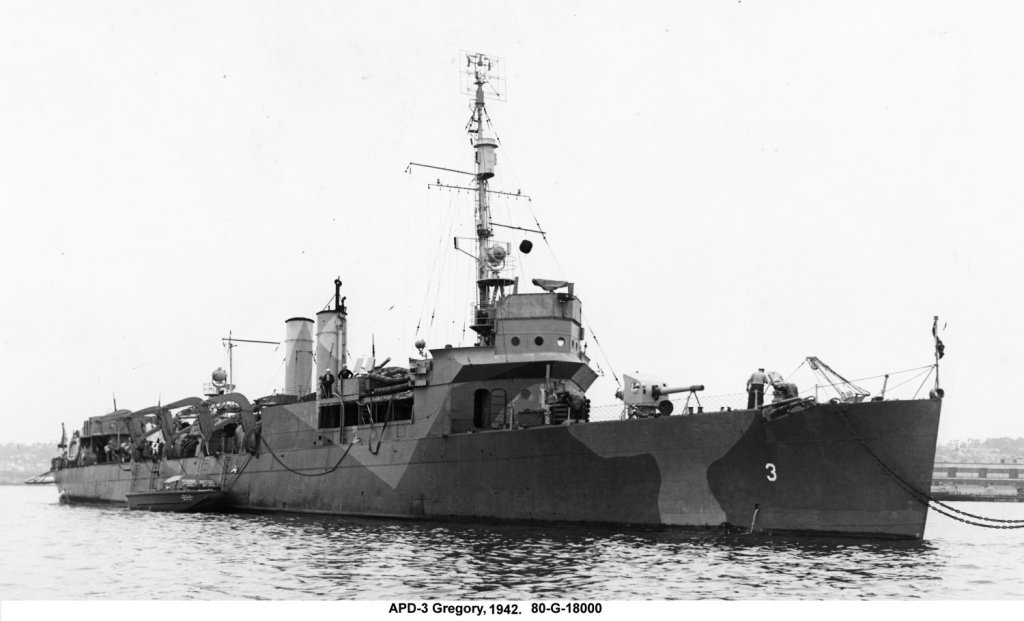
On 4 November 1940, Townsend was part of the commissioning of the converted Destroyer, U. S. S. Gregory (APD-3). While assigned to the U. S. S. Gregory, Townsend completed his training and was promoted to Machinist Mate Second Class, on 31 January 1942. The Gregory then made it’s way to Panama. Passage was made through the Panama Canal on 2 February 1942. The Gregory then arrived in San Diego, on 14 February 1942, where it underwent overhaul. Townsend and the crew of the Gregory trained the 1st Raider Battalion of Marines, off San Clementi, California. Later, the Gregory sailed to Hawaii, arriving at Pearl Harbor on 14 June 1942. After more training, the Gregory then participated in an attack of the Solomon Islands, on 7 August 1942. The Gregory was then sunk on the morning of 5 September 1942, at 01:15, while on submarine patrol. The Gregory had been attacked by three Japanese cruisers and one destroyer. The same day the surviving crew departed aboard the cargo ship William Ward Burrows (AP-6).
On 4 September USS Gregory (APD-3) and USS Little were returning to their anchorage at Tulagi after transferring a Marine Raider Battalion to Savo Island. At 0056 on the morning of 5 September, USS Gregory (APD-3) and USS Little -saw flashes of gunfire which they assumed came from a Japanese submarine until radar showed four targets-apparently a cruiser had joined the three DD’s. A Navy pilot had also seen the gunfire and, assuming it came from a Japanese submarine, dropped a string of five flares almost on top of the two APD’s. USS Gregory (APD-3) and USS Little, silhouetted against the blackness, were spotted immediately by the Japanese destroyers, Who opened fire at 0100. USS Gregory (APD-3) brought all her guns to bear but was desperately overmatched and less than 3 minutes after the fatal flares had been dropped, was dead in the water and beginning to sink. Two boilers had burst and her decks were a mass of flames. At 0123, with all of USS Gregory (APD-3)’s and most of USS Little’s crew in the water, the Japanese Ships began shelling again- aiming not at the crippled ships but at their helpless-crews in the water. All but 11 of USS Gregory (APD-3)’s crew survived, 6 of them swimming through the night all the way to Guadalcanal. USS Gregory (APD-3) sank stern first some 40 minutes after the firing had begun, and was followed 2 hours later by USS Little.
From: Naval History and Heritage Command
Townsend then made his way back to Pearl Harbor, arriving on 28 September 1942. He then was sent to San Diego, arriving on 13 October 1942. He took leave and arrived home in Marion County, on 21 October 1942. While home he married Dorothy (Lyon), on 28 October 1942. He returned off leave 11 November 1942.
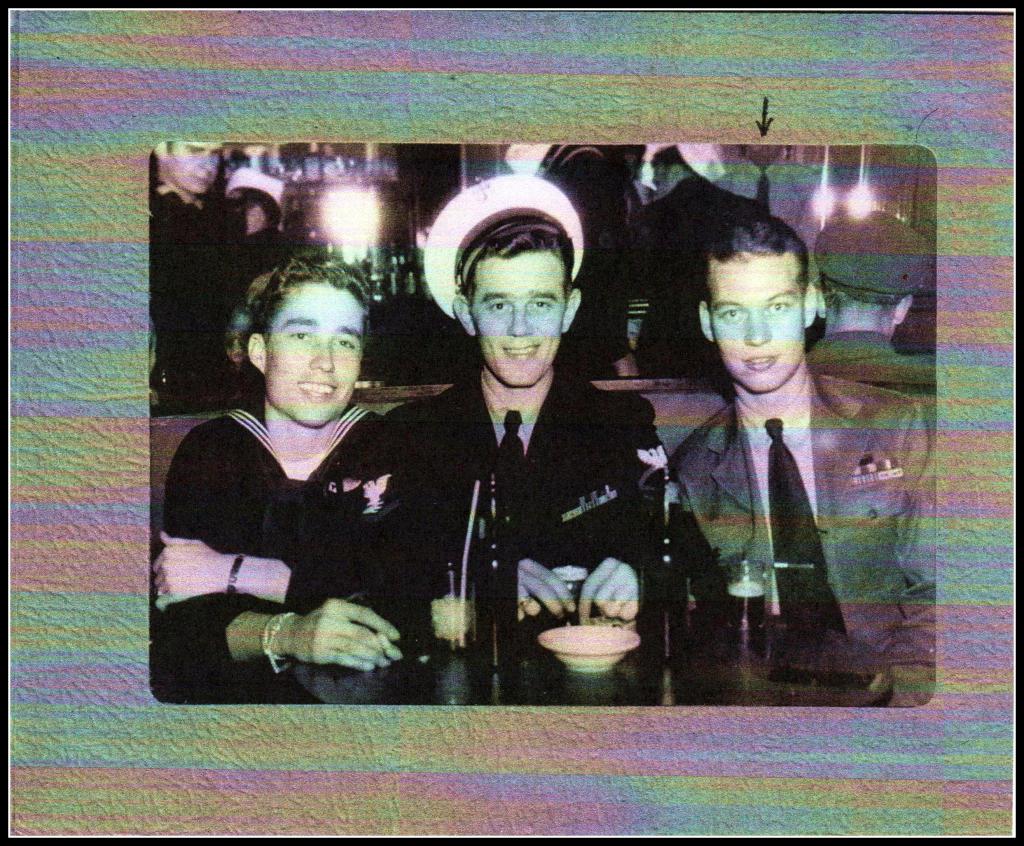
Townsend on Right
Townsend was reassigned to the U. S. S. Stevens (DD-479), on 1 December 1942. On 7 December 1942, he was able to return home again on Christmas leave. His wife, Dorothy was able to accompany him to Charleston. After training and escort cruises aboard the Stevens, they would pass through the Panama Canal and arrive in Pearl Harbor in August of 1943. On 1 September, along with 3 cruisers, 1 battleship, 3 light cruisers, 12 destroyers and one tanker, the Stevens arrived and began bombing the Marshall Islands. On 11 September 1943, they participated in the bombing of Japanese installations on Tarawa Islands. They also participated in bombings on Makin Island. The Stevens crossed the equator on the same date.
Townsend then returned to San Francisco for reassignment to the U. S. S. Cassin Young (DD-793). He then received delayed orders and was sent to Norfolk, Virginia, for engineering school at Naval Training Station, Naval Operating Base (N. O. B.). Upon completion of training, he left on 2 December 1943, for San Pedro, California. There he was back for the commissioning of the U. S. S. Cassin Young (DD-793). The Cassin Young was commissioned on 31 December 1943.
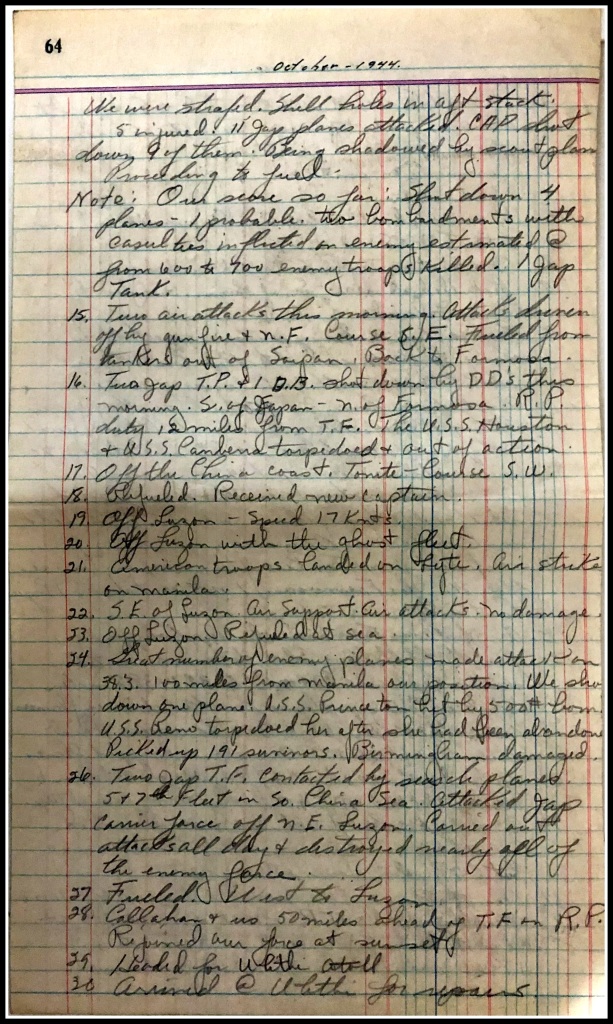
While aboard the Cassin Young, CMM Frank E. Townsend kept his own log of the ship’s operations. He logged the ship’s actions from it’s commissioning until the end of wartime service, 31 August 1945.
Excerpt from Townsend’s Log he kept while aboard the USS Cassin Young Oct. 24, 1944 “Great number of enemy planes made attack on [Task Group] 38.3 100 miles from Manila our position. We shot down one plane. U.S.S. Princeton hit by 500# bomb. U.S.S. Reno torpedoed her after she had been abandoned. Picked up 191 survivors. Birmingham damaged.”
While aboard the Cassin Young, Townsend appears to have lost two of his subordinates. They were killed in action. Townsend passed twice through the Panama Canal, crossed the equator, survived the sinking of the Gregory, survived many enemy attacks and still remembered those he served with by keeping records, photos and stories of their service together.
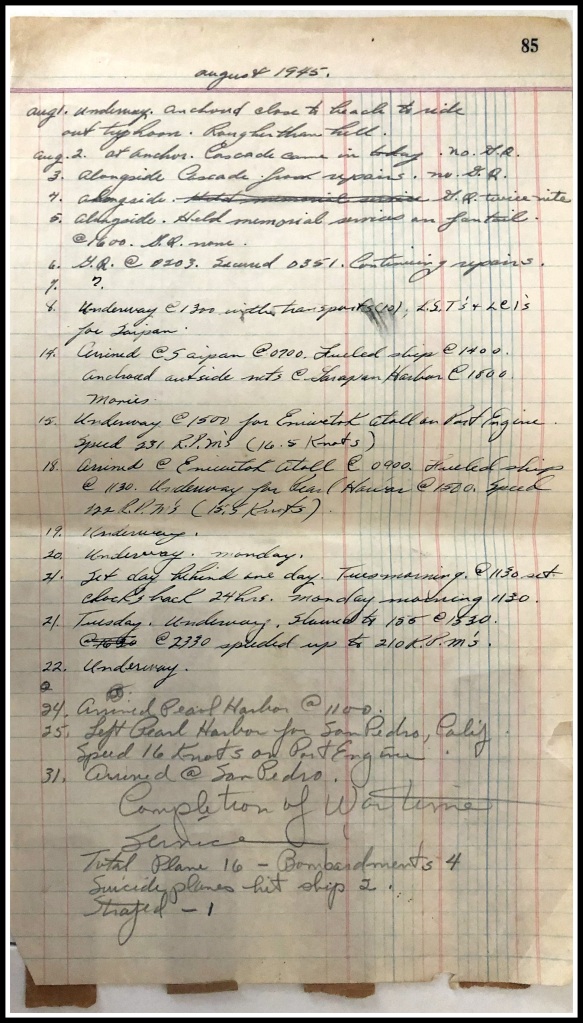
Excerpt of the “end of war” for the USS Cassin Young
“August 21, 1945 Set day behind one day. Tues morning @1130 set clocks back 24hrs. Monday morning 1130. [Crossing the International Date-Line] August 21, 1945 Tuesday Underway. Slowed to 155 @ 1530. @2330 speeded up to 210 R.P.M.S. 22, 1945 Underway 24, 1945 Arrived at Pearl Harbor @1100 25, 1945 Left Pearl Harbor for San Pedro, Calif. Speed 16 knots on Port Engine 31 Arrived @ San Pedro. Completion of Wartime Service Total Plane 16 – Bombardments 4 Suicide planes hit ship 2 Strafed – 1″ Transcribed from Townsend’s own Logs
He attained the rating of Chief Machinist’s Mate. Among his medals were the Asiatic-Pacific Area, 9 Stars; American Area; Good Conduct Medal; European-African Area; Philippine Liberation; American Defense and the Victory Medal World War Two. He was first Honorably Discharged from active service on 5 March 1946.
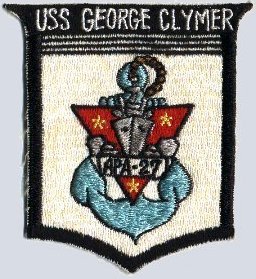
Frank E. Townsend would serve again during the Korean War. He began service on 15 July 1949. He was assigned aboard the U. S. S. George Clymer (AP-57, AP-27). The Clymer participated in the Inchon Landing from 15 – 17 September 1950. The Clymer would participate in other campaigns during the Korean War until July 1953. He was Honorably discharged again on 18 June 1953.
USS George Clymer (AP-57) returned to Inchon 8 October [1950] to embark Marines, and on 17 October she sailed for Wonsan, where she landed troops the 25th. Departing Wonsan 30 October, she steamed via Yokosuka to the United States and arrived San Diego 24 November. From: Naval Heritage and History Command
For his service during the Korean War, MM1C Frank E. Townsend was awarded the following; Korean Service Medal, 3 Stars; United Nations Service Medal; China Service Medal; and the Navy Occupation Medal (Asiatic).
Frank E. Townsend, like many veterans, experienced the loss of many friends. But during his service, he succeeded in military training, rights of passage (passing through the Panama Canal & Crossing the Equator and the International Date-Line), he faced attack by the enemy and participated in bringing the fight to the enemy. These are just some of the experiences that molded the men that were able to return home and make our communities what they are.
Frank E. Townsend returned to Marion and worked with the Ohio American Water Company. He raised his daughters in Green Camp, Ohio. Frank died in 1982, but is still remembered by those he knew and is remembered by his grand daughter, who shared his memories for this article.
Frank E. Townsend’s is remembered for his military service on the World War Two Memorial Wall at the Marion Cemetery
Harold Marvin Swihart was born on 28 July 1930. His parents are Dallas A. & Lena M. (Steinhilber) Swihart of Sycamore, Ohio. His mother preceded him in death. His obituary notice stated that he was a “native of Marion.” It is not known when he and his family left the Marion area, but he attended Sycamore High School.
Harold M. Swihart entered service on 10 September 1948. He was serving in Korea as a Master Sergeant (MSG) with the 7th Infantry Regiment “Cottonbalers,” 3rd Infantry Division “Rock of the Marne.” On the night of 24 May 1953, near Kumhwa, Korea, MSG Swihart was serving on a security group as a squad leader. They were ahead of the main battle line. Enemy forces began attacking the lines. MSG Swihart preformed his leadership duties by directing his soldier’s fire and moving about the line engaging the enemy. After throwing several grenades back toward the enemy, an enemy grenade landed amongst Swihart’s squad. MSG Swihart selflessly then threw himself on the grenade absorbing the blast. MSG Harold M. Swihart died of his wounds that night. For his “extraordinary heroism,” MSG Swihart was posthumously awarded the Distinguished Service Cross (DSC).
MSG. Harold M. Swihart was engaged to be married to Miss Martha Theil of Upper Sandusky, Ohio. He also left behind his father, two sisters and a brother.
MSG. Harold M. Swihart is buried in Pleasant View Cemetery, Sycamore, Wyandot County, Ohio. Harold M. Swihart’s name is not on any memorials in Marion, Ohio.
His selfless actions to his comrades and country were so revered, that Retired Judge Edward J. McLaughlin continued to pray for Swihart’s “immortal soul.” McLaughlin was the former Executive Officer of C Company, 7th Infantry Regiment, 3rd Infantry Division. Judge McLaughlin stated Swihart was a “courageous and honorable soldier.” He said he prayed each day for 40 years for Swihart, and on 24 May 1993, held a Mass in Swihart’s memory, at Holy Cross Church, in DeWitt, New York.
DSC Citation
The President of the United States of America, under the provisions of the Act of Congress approved July 9, 1918, takes pride in presenting the Distinguished Service Cross (Posthumously) to Master Sergeant Harold M. Swihart (ASN: RA-15415935), United States Army, for extraordinary heroism in connection with military operations against an armed enemy of the United Nations while serving with an Infantry Company of the 7th Infantry Regiment, 3d Infantry Division. Master Sergeant Swihart distinguished himself by extraordinary heroism in action against enemy aggressor forces in the vicinity of Kumhwa, Korea, on the night of 24 May 1953. On that night, a numerically superior enemy force began a probing maneuver in preparation for an attack on a strategic outpost forward of the main battle positions. Upon detection of the enemy, Sergeant Swihart, a squad leader of the security group, quickly moved among his men establishing a base of fire and directing their efforts to insure adequate support for a maneuvering element. As the aggressors continued their advance, Sergeant Swihart went forth to engage them, firing his weapon and hurling grenades to disorganize and retard their assault. As grenades landed amidst his men, Sergeant Swihart immediately threw them back at the enemy and, although completely exposed to the intense fire, he continued his aggressive action until the enemy was repulsed. In retreat, the hostile forces continued to throw grenades, one of which fell in the center of Sergeant Swihart’s squad. Realizing the imminent danger to his men, he sacrificed his life by hurling himself on the missile and absorbing the full impact of the explosion. The courage of Sergeant Swihart throughout this action not only was instrumental in repelling the enemy assault, but also saved the lives of many of his comrades.



 Honoring Marion Ohio Veterans