Pfc. Kathleen Brammer – Upholding A Family Tradition

Kathleen Brammer of Marion, Ohio, follows in her family’s standing tradition of military service to country. Her grandfather served in the Army Air Corps and later as a civilian contractor, her grandmother served in the Royal Canadian Air Force, her mother served in the United States Air Force, and her father served in the United States Navy. Kathleen is one of four siblings to serve in the armed forces; she has a brother, who served in both the U. S. Navy and U. S. Army; another brother who served in the U. S. Army; and a sister who served in the U. S. Air Force.

Brammer attended Pleasant High School and transferred to Harding High School for her senior year. While at both Pleasant and Harding, Brammer was part of the marching band’s color guard. During high school, Brammer would also attend Tri-Rivers Career Center, in the Cosmetology program, gaining her Esthetician certification. She was also trained in first aide and CPR. After graduation she decided to follow in her families tradition of military service, by enlisting into the United States Army.
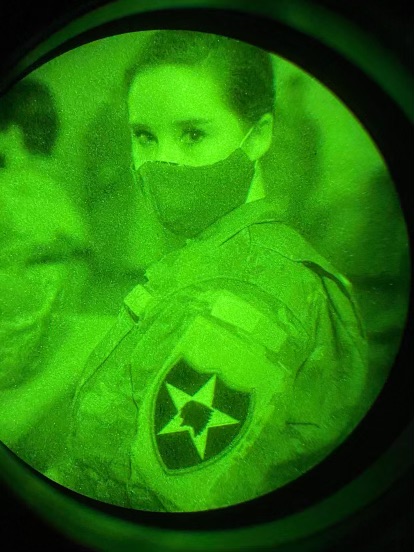
Kathleen Brammer started her basic training at Fort Jackson, South Carolina, in early 2020. She would be one of the first groups of trainees to train during the COVID-19 Pandemic. In the midst of training the armed forces as well as the rest of the world, would have to begin transitioning into the new and sometimes challenging, COVID precautions era.

When asked how did COVID affect you, she said, “Covid affected basically everything. Our families weren’t allowed to see us graduate either BCT (basic training) or AIT (advanced individual training). I didn’t see my family until I took leave a few months into being in Korea.” She also added, “Masking became routine. It was strange coming back and seeing people not wearing them. And there is a mandatory quarantine of 2 weeks when flying from the US to Korea. I didn’t mind it too much. It was fun, depending on the roommates.”

Brammer said she was able to write and receive letters while in basic training. She said they still used pen and paper, something that may have been foreign to the newer generation. But, mail call has been a lasting and ever cherished event in military service. She also shared that they were allowed 5 minute phone calls as they neared the end of the training cycle. This seems very much unchanged from when the author attended basic training over thirty years ago. Also, similar to past Fort Jackson veterans, she said she had to march and countermarch “Tank Hill.” And she said that she very much “hated it.” Another enduring part of training was the gas chamber and Victory Tower. Brammer said that she was very afraid of heights and the Drill Instructor (DI) could see it on her face. When she was getting in position at the edge of the tower, prepping for her repell, the DI put his boot on her shoulder as if to kick her off “his tower!” Brammer said she completed the confidence training at Victory Tower and would see the real life confidence she gained, while later at her permanent duty station.

After successfully completing basic training, Brammer would go on to Fort Lee, Virginia, for Advanced Individual Training (AIT). She would be trained as a 91-C “Utilities Repairer/HVAC Technician.” Brammer has memories of her and fellow trainees going to the Post Exchange (PX) to get snacks, which were not allowed in the rooms of trainees. They would buy the snacks and hide them all around their waistbands to get them into the quarters for a movie night. A little team building exercise.

After graduating from AIT, Brammer would be assigned to the 2nd Infantry Division “Second to None.” She was sent to her unit in South Korea. In Korea Brammer was promoted to the rank of Private First Class (Pfc.). This was her first experience outside of the United States. She would also have to learn to speak Korean, in order to get around; another first for her.
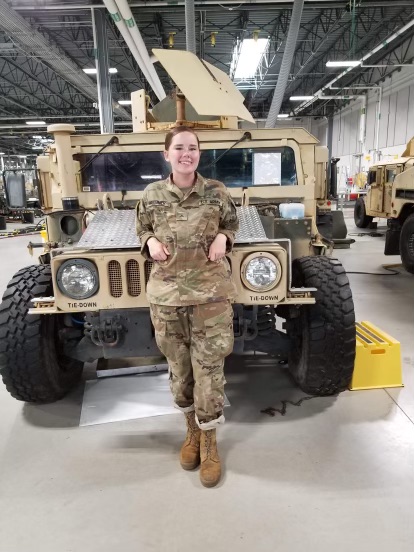
Pfc. Kathleen Brammer would get to use her new job skills while in real duty situations. She has earned the Army Achievement Medal and multiple Certificates of Recognition, for her successful task completions. One that she shared was when she was able to make repairs needed to a medical vehicle. The vehicle was in need of heating and air conditioning repairs. She had to use her skills to not only trouble-shoot the multiple problems, but had to improvise in making the repairs. She said she had to literally, “use my teeth to get the job done.” Thus, the medical vehicle and team were able to complete its mission. Pfc. Brammer was able to remain proficient in her skills, taught by the army, to help keep her unit “mission ready.”

Second Infantry Division Mission: The 2nd Infantry Division is the last remaining permanently forward-stationed division in the U.S. Army. The 2nd Infantry Division deters aggression and maintains peace on the Korean Peninsula; and if deterrence fails, “Fight Tonight” in support of the U.S-Republic of Korea Alliance.

From the 2nd INFANTRY DIVISION Page

Pfc. Brammer found that Korea was not as bad as many had said it would be. She said that duty revolved around many drills and real alerts. These drills were to maintain combat readiness.  These alerts consisted of much readiness exercises and standing in the old “hurry-up-and-wait” actions.
Author’s Note: South Korea is not a typical duty station. For several decades our military has been ready for a quick response to hostile actions from North Korea. It remains a real world hot spot and much posturing goes on to this day.

While in Korea, she enjoyed down time with fellow soldiers at the post bowling alley. She was also able to get off post, and into the civilian area and experience Korea. She would go sightseeing and even went bungee jumping, something she may never have attempted, had she not conquered some fears back at Fort Jackson’s Victory Tower.

Brammer says that she enjoyed the trips to Nami Island, which is near Seoul, South Korea. She stated that this island was very cultural and beautiful. The island has many tree lined paths and is known as a set for many movies. Brammer shared that, “Nami Island is a cultural area. With lots of museums, along with opportunities such as zip-lining, bungee jumping, and ATV riding. Brammer also said she enjoyed trying the local cuisine. She said, “The Korean food was amazing, although most things are much spicier than I expected.”
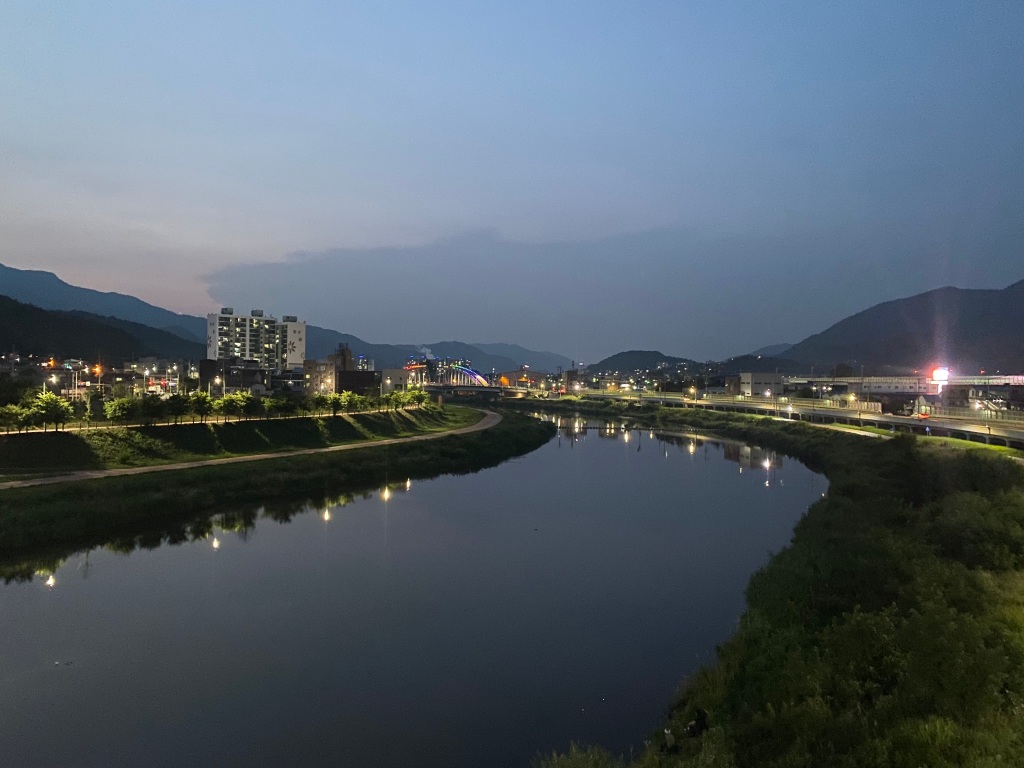
Korean Night Scene. Photo by K. Brammer

While in Korea, Brammer did get to see a fellow classmate also serving in the army. She was able to spend a brief visit with former Pleasant classmate. She also was able to have lunch with a couple of service members from Mt. Gilead and Columbus, Ohio. Social media, not available to many veterans of old, is a nice way for service members to keep in touch with friends and family and to learn if they are nearby.

So far, Brammer feels the military has helped her by challenging her both mentally and physically. She has been able to do tasks she would not otherwise have attempted. Now she feels she can better push herself to succeed in life in general. While in training, she wrote a note in her journal to herself. It was there to remind her of when things got tough to continue forward. It read, “Keep pushing. Even if you want to quit, just remind yourself why you came here. You’re stronger than you think you are.” She would remember the motivating quote throughout and always recalls it during challenging times.

Pfc. Brammer has some post-military goals. She hopes to return to school and get a degree in art and maybe become an art teacher. She even has ideas to become trained and work as an Emergency Medical Technician, to help get her through her schooling.

We thank Pfc. Brammer and her family who raised her in the tradition of service. Female veterans and service members are under-recognized on this blog, but their service is not forgotten and is very much appreciated.

Thomas J. Moon’s Last Written Words

PENS THRILLING WAR
TRIALS, THEN EXPIRES

Thomas J. Moon Stricken When
Writing Autobiography

MR. MOON SHOWS IRON
NERVE AT GETTYSBURG

When Pickett Makes His Great
Charge and Every Member of Bat-
tery A Is Killed Save the Marion
County Man–Rev. J. A. Sutton
Completes the Story.

Thomas J. moon Sr., whose death occurred Wednesday at his home at Meeker, was engaged in writing the history of his life and had been successful in recording the events up until his twenty-eighth year. Failing health compelled him to quit writing, after he had recorded the stirring experiences of the Civil War days.

Reverend J. S. Sutton, of LaRue, then finished Mr. Moon’s life story in obituary form.
Mr. Newman’s partial autobiography in the completion of his life story of the deceased, as written by Rev., Mr. Sutton follows:

Mr. Moon’s Own Story.
“Meeker, Marion County, O., June 23, 1913.
“I Thomas Moon, Sr., was born in Allegheny county, Pennsylvania, on October 24, 1836. My father, Solomon H. Moon, was a Cataraugus county, New York state man, and my mother came from Switzerland with her parents when young. Was married in Allegheny city about 1832. I removed with my parents to Frankfurt, Kentucky, in 1837. My father died there in 1838. My mother, being left a widow with a boy and girl, was remarried in 1840 to Andrew Sharp as good as stepfather has ever lived. He treated my sister and myself well and I can’t say that I always deserve good treats.

“We lived at lock, No. 4, on the Kentucky river, across the river from Frankfort, until 1852, when we removed to Marion, Ohio. The first year we built for miles of railroad, 2 miles east and two miles west of what is now called Longville, on the Bellefontaine & Indiana railroad, which is now called the Big Four.

Moves To Marion.
Then I moved to Marion in 1853 and built a house on Center street in Kenton avenue. The next year was the cholera, 1854, not much done though. I butchered in Marion until the war broke out. I enlisted in company K, Fourth O. V. I., on April 16, 1861, to serve three months. I was then between twenty-four and twenty-five and was a better man than I have ever been since. We were foolish enough to elect a man, because he had been to Mexico, first lieutenant of the company. We found our mistake later. He got the swell head and made it unpleasant for all of us, so six of us agreed that the first man that could get a fuss out of him had to strike him.
“I, of course, was the unlucky man, and it raised a big fuss in camp. He would not appear against me the next morning, so I was released. He being a commission officer, he resigned.
“I have been on detailed duty a second sergeant to assist the quartermaster in issuing rations and handling meats. Got into a fuss with Captain Brown at Burlin, where we cross the Ohio river and of course, he forced me back to the company.

Reenlisted for Three Years.
“We got our guns on June 6, reenlisted for three years more service and started for Virginia. We left the cars at Clarksburg and took a hike across the mountain to Brecannon, from there to Middle Fork bridge. There we saw the first dead men. We stayed there that night, then on to Richmond, where we had what we thought a big battle, as we saw about 250 dead. We tramped on across the mountains and landed at Beverly the same night. The next day some of the Indiana troops routed some of the rebels at Laurel hill, and headed down toward us. We got 600 of them surrounded that night. Well, that was the first night I ever was on Pickett and I was not scared, but there was something cold kept crawling up my back.
“Well, in the morning we captured the whole bunch, then we went to Webster and took the cars for Paw Paw tunnel. We were then under General Lauder and it was February, 1862. The quartermaster of the division was named Ambrose Thompson, lieutenant commander and United States quartermaster.

Division Forage Master.
“I was detailed along with some others to reload the cars of corn and hay. Thompson asked me if I could issue corn and head to the cavalry and mule trains. I told him I could. I filled out all the requisitions and, at night, when I made my return, he told me he wanted me at headquarter and he would have me detailed as forge master in division
“Next morning he sent me an order, signed by himself and General Lauder, so I acted in that capacity until the next September. I was forge master at Paw Paw Tunnel, Martinsburg and Winchester, and when we started up the valley, I had charge of the headquarters’ train. Well, I acted as wagon master until September, 1862, when we got to Port Royal. General Shields was relieved and the division was broke up and I was sent back to the regiment. Of course, after riding a good horse for seven or eight months, I did not like walking and carrying a gun and knapsack, so I made application for a transfer to battery A, Fourth United States artillery.

A Good Artilleryman.
“I happen to get into the best battery in the United States and will say I made a good artilleryman. Of course, we had more danger, though. I had a good horse to ride a good time generally, but had to obey orders.
This is November 2, 1913, and I have put off writing this as I can neither right nor dictate as I could years ago, though I will do the best I can. I liked the drill and discipline and I like the noise of the big guns. Our battery, as I will call it hereafter, took part in the battle of Fredericksburg, Chancellorsville, Antietam, Mine Run, and all the engagements with the Army of the Potomac, and never got a bad knock out until the battle of Gettysburg.
There we lost forty-four men, and three commissioned officers and sixty-eight horses, when we only had ninety men and ninety horses on the firing line, or what is called the bloody angle of high water mark, on the third day.

Batteries Consolidated.
Of course, we had to watch the enemy, not knowing what move they were going to make next. I battery, first artillery, was knocked out about as bad as ours and so they consolidated the two batteries and all we could man was four guns and what was left of the twelve guns we had in the start. Our guns of battery A are still on the field, where they were left the evening of the third day after the famous charge of General Pickett’s Infantry. I, with the rest, was on that field for five days without much to eat – just laying around our guns, watching the enemy, and not in any shape to attack them, as we were in about as bad a shape as they were. We rode off on that ridge and left our comrades a-laying over that ground, and one of our men left his brother laying there dead. A man that never saw a big battle has no idea of what it looks like to see 50,000 and more horses and more horses laying over the ground for two or three miles and lots of them have been a-laying there for three days and that within fifty miles of Washington, Harrisburg, Philadelphia and Baltimore. There were horses swelled up to bursting and their legs sticking up and telling one that war is hell.

Hardest Time of Life.
“I had the hardest time of my life for the five days on that battle field for a strain on my nerves and from all causes. I am not ashamed of the fact that I was the only man that was not killed that was helping the work No. 4 piece, as that was the first gun the Johnnies run over by General Armstead’s brigade, and Armstead was killed. He fell right at the left wheel of No. 4 piece. I did not think there were rebels enough in the Southern confederacy to run over that line of artillery, though they kept coming until they did run over us. The gun was fully manned when I left her.
“I saw the limber that was not exploded and I went back to hunt more canister, as we were fire and canisters and double shooting the guns. When I left her everybody was on the run, I found no canister and started back to the gun. I looked up and saw Commander Cushing fall, and saw some man catch him in his arms. He was on the right of the gun and he was killed.

General Armstead Killed.
“Just in General Armstead jumped the wall with his hat on the point of this world, and yelling something to his men, though the Johnnies were coming over the wall like a swarm of bees. Armstead can’t hold of the left wheel of the piece and fell right there. I suppose that is where he got his death wound, though I have heard he died in the hospital. Alonzo Cushing was wounded first by a piece of shell through the thighs in the second time he was struck by a small piece of shell in the right shoulder that cut his shoulder about off. I happen to be sergeant of the guard on duty that night. The battery was all scattered and we have nothing to guard except a few dead men and we managed to get off the field, Cushing among the rest. I slept on top of Cushing all night, as it kept me out of the water, it rained all night. The next morning was July 4, 1863. His colored man was called Henry and myself took off his fatigue blouse and put on his dress coat and cut the shoulder straps from the fatigue blouse and kept them and gave the blouse to the colored man. I kept the shoulder straps until the next winter, then gave them to his brother, Howard Cushing, at Brandy station, Virginia, as Howard was with us for a while in winter quarters at Brandy station.

In Twenty-Seven Battles.
“I was through all the battles of the army of the Potomac and there are twenty-seven of them down on the back of my discharge and they gave me an excellent character. That is something that a great many regular army men do not get. Well, we follow the rebel army up with the varied successes to the Potomac river at Williamsburg, when we got ready to attack. But they nearly all got across the river. Then they sent our battery to Washington. They are we got an entire new outfit of guns, horses, harness and sixty new men. By the time we got our men and horses drilled my time was up and I was glad to go home. I shall have to explain by the time we got our men and horses drilled my time was up and I was glad to go home. I shall have to explain how I came to be absent from the guns at Gettysburg, when the rebels ran over us and killed all the men that was there, my chief’s name was Sergeant Murphy. His time would have been up on July 4. He was killed on the second. I being in command of No. 4 piece I was in command.

Falls Among Dead.
“Cushing was in command of the right section, No.2. His guns were dismounted so he and his men drifted down to number 384. Of course, Cushing took the command out of my hands, so I went back about twenty-five yards to hunt more canister, when I looked to the front and saw the rebels coming over the walls, I was between two fires, as our infantry was back of me, I threw up my hands and fell among the dead men and dead horses, I do not believe I have nerve enough to let a brigade of men run over me. One man stepped on my neck, but I stayed still.”
That is as far as Mr. moon got.

Rev. Mr. Sutton’s Obituary.
In the obituary prepared by Rev. Mr. Sutton, after stating the date and place of Mr. Moon’s birth, it is added that the decedent was married to Miss Mary Craner, of Marion, March 30, 1864, and departed this life, December 23, 1914.
“To this union,” says Rev Mr. Sutton, in speaking of the marriage, “was born thirteen children. They are Mrs. W. E. Hatfield, ES moon, of Marion; Mrs. W. L. Mears, of Meeker; Mrs. U. E. Partridge, of Roseville California; J. E. Moon, of Mansfield; Thomas J. Moon Jr., of Marion; G. A. Moon, of San Francisco California; H. L. Moon, deceased, died December 31, 1898, at the age of twenty-one years and four months; Mrs. L. W. Thomas, of Los Angeles; Mrs. G. W. Riley, deceased, died March 19, 1913, at the age of thirty-one years, six months and eleven days; Mrs. C. M. Cookstan, of Meeker; Mrs. Charles spread and Mrs. Charles Lamb, of LaRue.
“Brother moon leaves to mourn his loss a kind and modest wife, two sisters, Mrs. William Godding, of Girard, Kansas, and Mrs. T. A. Thompson, of Marion; eleven children, twenty-seven grandchildren and many relatives and neighbors.
“He joined the Methodist church at Meeker about twenty-five years ago, and had lived a conscientious life. Mr. Moon had the pleasure of living through seventy-eight of the best years the time has ever yet parceled out of to mankind. The onward march of the events had given to him one continuous panorama of his long and splendid voyage.”

His Iron Nerve.
Mr. Sutton then covers much of the same ground covered by Mr. Moon his own life story. After describing Mr. Moon’s experience on the battle field, when he fell among the dead and dying to escape certain death if he had remain standing,
Mr. Sutton adds:
“Such was the iron nerve of this veteran. And when we think how he reenlisted to face the dangers over again in storms of shot and shell, our feeble minds like the words to express his worth. Thus the impress on his memory is not stamped there by pictures, but by realities; not by reading novels and seeing pictures, buy by downright experience, privations and exposure. And when the lull of ambition seemed coming on and a portion of life have been lived up, he settle down in the quiet village of Meeker, in a neat home, with a nice family, and calmly watched his life’s evening horizon purple, when lo; there appeared the fatal malady, with its suffering, and blighted the peace and quiet of age. Knowing he could not live long, he called the family to his bedside, and bid them an affectionate farewell, fully assuring them that he was prepared and, calmly as the day dawns, passed into the silent land.”

Autobiography by Thomas J. Moon
Marion Daily Star dated 12-28-1914

World War Two Hero’s Funeral Flag Returned to Marion, Ohio

In June of 2021, David DeHart and his wife, drove from Bryson City, North Carolina to Marion, Ohio. They came to return a World War Two Funeral Flag to the hometown of Lt. Walter L. Ruzzo. Mr. DeHart had contacted me and asked that I get him in contact with Heritage Hall and also to help find a way to tell the story of Lt. Ruzzo. Together we were able to get the flag into the hands of Heritage Hall. We also, arranged for the flag and the story Mr. DeHart wrote, to be displayed at the Marion Municipal Airport. We felt since Lt. Ruzzo was an aviator, that this would be a good place to have them displayed.
I would like to thank Mr. DeHart, a retired Sergeant Major of the United States Army and Vietnam War Veteran and Justin Kirkland, the savior of this flag and memory of Lt. Ruzzo, for all they have done to preserve the memory and honor one of our veterans.
We also learned of another Marion Veteran, Lt. Gerald E. Hamilton, who was in the same unit as Lt. Ruzzo. Please follow the links to read about these heroes connection.
The following story was researched and written by David C. DeHart, 2021
Bryson City, North Carolina
:

WWII Hero Killed in Action

Netherlands American Cemetery and Memorial is a Second World War Military War Grave Cemetery, located in the village of Margraten, Netherlands. This Soldier rests there alongside 8291 other Heros.

Story and Research by David Charles DeHart 2021
Bryson City, North Carolina

The Burial Casket Flag for WWII Soldier
1st Lt Walter L Ruzzo
Going Home

Justin Kirkland of Bryson City, North Carolina holds a 48 Star American Flag that he found and purchased at an Antique Auction House in Waynesville, NC several years ago. David DeHart is holding the Box that the flag was packed in and sent to the surviving spouse in May 1949. This flag draped the Casket of a WWII Soldier, 1st Lt Walter L Ruzzo from Marion, Ohio he was Killed in Action. He was buried in a US Military Cemetery in Netherlands. Justin has always wanted to know more about this flag, so asked his Grand Mother, Verna Kirkland, who works at the Swain County Historical and Genealogical Society for ideas in finding out who this WWII Veteran was. Verna then reached out to David DeHart, a Veteran and Vice President of the Genealogy Society who then started looking and digging into this mystery.

“This is what I love to do and I really wanted to dig into this story because this was a WWII Soldier, I am a Retired US Army Vietnam Combat Veteran and my Dad was a US Army WWII Combat Veteran, so this is very important and dear to me. That’s when the story and history of this Veteran started to unfold and with information from Ancestry, this Soldier’s life was uncovered and presented the following Story”.

Walter L Ruzzo was born 18 October 1917 in Marion, Ohio. His parents were immigrants from Italy. His Father was a Barber and his Mother was a Beautician. Walter also had two brothers, Edward (older) and Frances (younger). He graduated Harding HS and went on to study Journalism at Ohio State University. In May 1942 he entered the Army Air Force and trained at Santa Ana, Calif. Walter met Rose Margaret Evans in college they married July 20th, 1943 at Baer Field, Fort Wayne, Ind. where he was last stationed. Rose Margaret Evans was born March 1917, her parents were immigrants from Austria, and they owned a Rock Quarry Business in Marion, Ohio. Soon after their marriage, Walter was shipped overseas in August 1943, sadly this may have been the last time he saw his wife. He was a Navigator and Co-Pilot on a C-47 which was a Military Transport Aircraft in WWII. Both of his brothers were in the Service at this time, Edward was a Legal Officer for the Army in San Francisco, Calif. and Frances was a Navigator and Co-Pilot on a B-24 Bomber also stationed overseas during WWII.
The following is research into LT Ruzzo’s military service. He was trained as a Pilot and Navigator in Santa Ana, Calif. in 1943-1943 after he enlisted 24 March 1942 at Fort Hayes, Columbus, Ohio. He is shipped out overseas in August 1943 after his marriage to Rose Margaret Evans records show that they were married for about 1 month before he departed. Military records show that he flew the C-47 Troop Transport plane over Sicily during the early stages of WWII in what was called the Sicilian Invasion and Sicilian Campaign where Paratroopers were dropped. It is noted that Lt Ruzzo received the Air Medal for combat service over Italy. He received the Mediterranean Theater Medal for Submarine Patrol and a Star for his African Theater Medal for action in the Sicilian Campaign. Records also show that he was a patient at an Army hospital in January 1944 for an unknown cause. A letter to his family dated March 1940 stated that he was in France.

Operation Varsity was the First Airborne Operation where the C-46 airplane was used for dropping Paratroopers. The C-46 could carry double the number of Paratroopers that a C-47 could carry. The exit time for the Paratroopers was greater because the C-46 had two exit doors, one on each side of the plane. The 313th Troop Carrier Group had the honor to use the C-46 in this combat operation. The Group was based at Achiet, France.

The four Squadrons were divided into two serials. The 49th Troop Carrier Squadron was leading in Serial A-5, followed by the 29th Troop Carrier Squadron. The next serial, A-6, was flown by the 48th Troop Carrier Squadron and, as last in the line, the 47th Troop Carrier Squadron. Each consisted out of 36 aircraft. The two Squadrons in Serial A-6 did dispatch 18 aircraft each. The 48th Troop Carrier Squadron planes had a chalk number 36-54 (18 aircraft).

The Douglas C-47 is a military transport aircraft developed from the civilian Douglas DC-3 airliner. It was used extensively by the Allies during World War II and remained in front-line service with various military operators for many years.

On March 24th, 1945 the flowing report was filed by an “Eyewitness” accounting for a C-47 Plane that was last seen and assumed crashed.
for a C-47 Plane that was last seen and assumed crashed.

This article was printed in the Marion News Paper, March 1945

Eye witness account


Beginning of Statement:
“I, Lt. Glen H. Smith, was flying on the right wing of the C-47 airplane piloted by Lt James F. Claussen. After they had dropped their Paratroopers on the DZ (Designated Zone) they made a right turn-off and the airplane was last seen my me with the left engine on fire heading back toward the Rhine River. The airplane, chalk #52 was under good control and about 100 feet off the ground.” End of Statement.
There were 5 Crew members on board. Pilot James F. Claussen Co-Pilot Rubin Levy, Navigator Walter L. Ruzzo and Radio Operator George J. Kuhn were killed in action. Only T/SGT Charles L. Williams, Crew Chief, survived. He was partially out of the side escape hatch when the aircraft crash landed and as a result he was thrown clear of the wreckage and unconscious. German Medics carried him, seriously wounded, to a cellar dressed his wounds and departed. He was later found by American Forces and saved.


In addition to Lt Walter L. Russo’s Medals he was also awarded the Purple Heart. He was laid to rest in the American Cemetery, Margraten, Netherlands alongside of 8,291 fallen soldiers of War. This Flag is called a “Burial Casket Flag” and was the flag that covered his casket before burial. His Flag was packed into this box that I am holding and was sent to Rose Margaret Ruzzo, his wife that was living in Columbus, Ohio with her parents at the time he was killed in action. The address label is from the US Government and is clearly post marked from an APO (American Post Office) Margraten US Cemetery. Post marked May 1949, why the difference in years is unknown. Contents on the label are: U.S. FLAG (Ruzzo, Walter L. 1/Lt. 0-744867).

Packed inside the box containing Lt Ruzzo’s Burial Flag was this letter explaining the purpose of the Flag. It also explains that it was used to cover her husband’s casket during burial services held at the time he was laid to rest in a Military Cemetery overseas. This letter was sent from the Department of the Army, Office of the Quartermaster General, Memorial Division, Washington, DC. May 1949

Little is known about Walter’s marriage to Rose Margaret Evans. Records show that they were married 20 July 1943 at the Post Chapel on Baer Field, Fort Wayne, Indiana by Army Chaplain William Cyraw. Lt Ruzzo then departs for overseas duty in August 1943. After studying many records, I am not sure if they ever saw each other again. There were several records of letters between the two. Records show that both her parents, immigrants from Austria, remained and died in Marion, Ohio and are buried there. It seems that she never remarried and died 18 February 2013 at the age of 95. There was no funeral and records show that she was cremated.
After researching Walter’s family, I found the following information about his two brothers…The older brother Edward J. Ruzzo was born 29 Sept. 1912. He also graduated Harding HS and received a Law Degree from Ohio State University in 1937. His Law practice was interrupted March 15th 1941, when he entered the US Army and was returned to Enlisted Reserve Corps because he was over 28 years old. He was recalled to active duty in October 1942 where he worked as an Intelligence Officer with the Grade of Special Agent until his discharge Dec. 17, 1945. Edward went back to practicing law in Marion, Ohio and later served as City Councilman. After many years in Law, he became Judge Edward James Ruzzo and the city of Marion named a Detention Center in his name. He was married and had two sons and two daughters. Edward died on October 9th 1996 at the age of 84. Edward’s wife Katheryn was a school teacher she was born November 8th, 1917 and died at the age of 103 on December 2, 2020 while living in Fort Wayne, Indiana. The younger brother, Francis A. Ruzzo was born September 29th, 1920 in Marion, Ohio. He also attended Harding HS and studied at Heidelberg College where he met his wife Ann Nuttall. He also attended Ohio State University before enlisting into the Air Force in 1942. Before reporting to active duty, he and Ann married December 27, 1942. Frank served as a Navigator and Pilot (like his brother Walter) on a B24 Bomber with 404th Bomb Squadron of the 11th Air Force in Adak, Alaska. During his four years of service, Frank flew over 100 hours of combat duty and was a Second Lieutenant.

For his service to his country Frank received the Distinguished Flying Cross and the Air Medal with Two Oak Leaf Clusters. Upon his discharge, he attended Kent State University and graduated Magna Cum Laude with a BS in Business Administration in 1947. After graduation, Frank and Ann moved their family to Santa Clara, California and became a Senior Partner in the Accounting Firm of Peat, Marwick and Mitchell. Frank died August 24th, 2008 he was 79 years old. Ann died 21 March 2015 at the age of 97. They had one son and two daughters.
The parents of these three WWII Veteran heroes are James and Florence (Viggins) Ruzzo both were immigrants from Italy and came to America around 1906. James and Florence started their venture in Passaic, New Jersey around June 1911 and moved to Marion, Ohio where they opened a business as a Barber and Beautician. Information on James Ruzzo shows that he was born Jan. 17, 1893 and Florence was born in 1899 that may not be correct according to the 1920 US Federal Census. This wonderful and hardworking family also had Florence’s Mother and Father living with them in 1920, 1930 and 1940 as listed on the US Federal Census. James died in 1967 and Florence died 3 Apr 1974. What a remarkable family and a wonderful story. RIP Sir and Thank You for your Service

Lt. Walter L. Ruzzo’s Headstone at Netherlands American Cemetery, Margraten, Netherlands

I have contacted the Marion County Historical Society and have emailed their Director. I will be planning a trip to Marion, Ohio sometimes this spring to meet with their Marion Historical Society and Museum where Judge Edward Russo, is honored for his contributions and work for the City of Marion. I am hoping that they have a place where Lt Walter Ruzzo’s Burial Casket Flag and the Box it was returned in as well as my Research Paper on this WWII Veteran could rest next to his brother. As a 28 year career US Army and Vietnam Combat Veteran also the Vice President of our Genealogy Society in Bryson City, North Carolina it will be an honor to take this Flag Home. Most of all…a special “Thank You” to Mr. Justin Kirkland of Bryson City, North Carolina who made all of this possible by finding this so very special Flag.
A special thanks to Susan Matthews (President) Marion Area Genealogical Society for emails and help with old newspaper articles and Ruzzo Family information. Other information from Military Records and Ancestry Records.

Thank You, Justin Kirkland & David DeHart for Honoring Marion Veteran, Walter L. Ruzzo’s Service and Memory, as well as the service and sacrifice he and his family made for our community.

Lt. Walter Ruzzo’s Funeral Flag (Returned to Marion, Ohio) on display at the Marion Municipal Airport. Thank You to Airport Director, Matt Arnold and staff, for honoring these veterans.

Lt. Geneva Imbody – World War Two Veteran

Geneva (Imbody) Whittridge was born on 31 August 1914. Her parents are William A. & Lydia S. (Schwaderer) Imbody of New Bloomington, Ohio. She was a graduate of Agosta High School, Class of 1932. She would marry Burdell Whittridge, on 23 July 1949, in Green Camp, Ohio.
Geneva graduated from Grant Hospital Training School for Nurses, in 1937. She would attend graduate school at University of Chicago, Illinois and graduate in 1941. She then would work as Supervisor of Surgery, at Grant Hospital, Columbus, Ohio.
In February of 1941, Geneva (Imbody) would enter service with the United States Army, Army Nurses Corps (ANC). She would attend training at Fort Jackson, South Carolina. Later in 1941 she would be sent overseas to serve as a Second Lieutenant.

Lt. Geneva (Imbody) would serve for five years with the ANC. She would see service in Africa, Sicily and Italy (Anzio Beach). Lt. Imbody served with the 15th Evacuation Hospital, 5th Army. Among her awards she was awarded six Campaign Stars and the Presidential Unit Citation. Lt. Imbody was honorably discharged in May of 1946.
While serving in Italy, Lt. Imbody would get a chance to be reunited with her brother, Sgt. William D. Imbody. The Marion Star would report on the meeting of the siblings.
After military service, Geneva (Imbody) Whittridge would work for 53 years as a nurse. She worked for Dr. Frank Murphy; worked at Crile General Hospital in Cleveland, Ohio; and worked in nursing homes in Marion, Upper Sandusky and Kenton, Ohio.
Geneva (Imbody) Whittridge died 25 September 1998, and is buried in the Marion Cemetery.
Geneva (Imbody) Whittridge is remembered on the World War Two Memorial Wall at the Marion Cemetery.

Staff Sergeant Workman – Navy Cross Recipient

Staff Sergeant Workman was born on 26 August 1983, in Marion Ohio. Prior to graduation from North Union High School in Richwood, Ohio, he enlisted in the Marine Corps on 28 August 2000, and reported for recruit training at Marine Corps Recruit Depot, Parris Island, South Carolina on 19 August 2001 and graduated on 16 November 2001. Upon graduation, he reported to the School of Infantry, at Camp Lejeune, North Carolina, where he attained the MOS of 0341 (Mortarman).
In March of 2002, Private First Class Workman reported for duty at Marine Corps Security Forces Company in Kingsbay, Georgia. He was then assigned to 3rd Battalion, 5th Marines at Camp Pendleton, California where he served in Weapons Company with the 81mm Mortar Platoon as a team leader and then as squad leader.
In September of 2004, Corporal Workman deployed to Iraq and participated in Operation
Phantom Fury. On 23 December 2004, he led his squad in three separate intense fire fights during clearing operations in Al Fallujah resulting in the rescue of injured Marines. His heroic actions contributed to the elimination of 24 insurgents, and he was awarded with the Navy Cross.
jeremiah-workman-navy-cross-ceremonyFrom March 2006 until September 2006, Sergeant Workman served as a Drill Instructor with Delta Company, 1st Recruit Training Battalion.
In September of 2006, Sergeant Workman reported for duty at Training and Education Center Company, Headquarters and Service Battalion, Marine Corps Base, Quantico, Virginia.
In June of 2007, Sergeant Workman reported for duty at Headquarters, United States Marine Corps, Washington D.C. for duty with the 16th Sergeant Major of the Marine Corps.
WorkmanIn August 2008, Staff Sergeant Workman reported for duty at Wounded Warrior Regiment, Quantico, Virginia and was medically retired from the Marine Corps on 30 January 2010.
Following his medical retirement, he began serving as the Military Services Coordinator for the Department of Veterans Affairs.
In September 2009, both Jeremiah Workman and John Bruning authored the book “Shadow of the Sword”, a memoir that brilliantly captures both wartime courage and its lifelong consequences.
Staff Sergeant Workman’s personal awards include the Navy Cross, Purple Heart, Navy and Marine Corps Achievement Medal, and the Combat Action Ribbon.
Jeremiah Workman is married to the former Miss Jessica N. Jordan of Marion, Ohio. They have a son, Devon and a daughter, Delaney.

I would like to thank Jeremiah Workman for providing the above bio. Below you can find a link to the book he authored to bring awareness to PTSD.

Shadow of the Sword by Jeremiah Workman

Veterans Crisis Line

Further reading

nvycrossNavy Cross

Awarded for Actions
During: Global War on Terror
Service: Marine Corps
Battalion: 3d Battalion
Division: 1st Marine Division
GENERAL ORDERS:

CITATION:

The President of the United States of America takes pleasure in presenting the Navy Cross to Corporal Jeremiah W. Workman, United States Marine Corps, for extraordinary heroism while serving as Squad Leader, Mortar Platoon, Weapons Company, Third Battalion, 5th Marine Regiment, Regimental Combat Team 1, FIRST Marine Division, U.S. Marine Corps Forces, Central Command in support of Operation IRAQI FREEDOM on 23 December 2004. During clearing operations in Al Fallujah, Iraq, Corporal Workman displayed exceptional situational awareness while organizing his squad to enter a building to retrieve isolated Marines inside. Despite heavy resistance from enemy automatic weapons fire, and a barrage of grenades, Corporal Workman fearlessly exposed himself and laid down a base of fire that allowed the isolated Marines to escape. Outside the house, he rallied the rescued Marines and directed fire onto insurgent positions as he aided wounded Marines in a neighboring yard. After seeing these Marines to safety, he led another assault force into the building to eliminate insurgents and extract more Marines. Corporal Workman again exposed himself to enemy fire while providing cover fire for the team when an enemy grenade exploded directly in front of him causing shrapnel wounds to his arms and legs. Corporal Workman continued to provide intense fire long enough to recover additional wounded Marines and extract them from the besieged building. Although injured, he led a third assault into the building, rallying his team one last time to extract isolated Marines before M1A1 tanks arrived to support the battle. Throughout this fight, Corporal Workman’s heroic actions contributed to the elimination of 24 insurgents. By his bold leadership, wise judgment, and complete dedication to duty, Corporal Workman reflected great credit upon himself and upheld the highest traditions of the Marine Corps and the United States Naval Service.