Jack Ermen Holt was born on 4 February 1925, in Higginsport, Brown County, Ohio. His parents are Jack E. & Lorena (Shumaker) Holt. Jack relocated to Marion, Ohio, from Hillsborro, Ohio, when his father became head of the Marion City Schools. Jack’s father was the Superintendent of the Marion City Schools. Jack was a 1943 graduate of Harding High School. At Harding, he was a member of the National Honor Society, Hi-Y Club, was a member of the band. He was also very involved in many other extra curricular programs. He had also worked at J. C. Penney Company and the Marion Paint Company, prior to being inducted into service.
Jack E. Holt was inducted into the Army on 12 July 1943. Holt attended basic training at Camp Fannin, Texas. He then went to North Georgia College, and enrolled in the Army Specialized Training Program (ASTP). He then went to Camp Gordon, Georgia for further training. He went overseas after Camp Gordon and arrived in France.
While in France Holt served as a Sergeant (Sgt.), with 10th Armored Division “Tiger,” in the 20th Armored Infantry Battalion. It appears he was killed in action (KIA) while fighting near Saarbrucken, Germany. Sgt. Jack E. Holt was killed in action on 30 November 1944, in Germany. Sgt. Jack E. Holt is buried in the Arlington National Cemetery, Section 12, Site: 497.
Sgt. Jack E. Holt is remembered on the Honor Roll, at the Veterans Memorial Park, in Marion, Ohio; on the west wall of the Marion County Courthouse; and on the World War Two Memorial Wall, at the Marion Cemetery.
Russell Paulson Britton was born on 4 August 1917, in LaRue, Ohio. His parents are William F. & Annora R. (Paulson) Britton of LaRue, Ohio. Russell P. Britton had attended school in LaRue. He then worked at Pollak Steel Company.
Russell P. Britton enlisted into the United States Army on 14 November 1941, at Fort Hayes, Columbus, Ohio. He was assigned to Camp Wheeler, Georgia at the time of his death.
Russell P. Britton was home on leave and became despondent about returning to the Army. Britton died on 23 December 1941, of a self inflicted gunshot wound. His body was found on Marion’s west side near the stockyards. A letter to his family was found on his person indicating his state of mind about returning to Camp Wheeler. Russell P. Britton is buried in Fairview Cemetery, LaRue, Ohio.
Russell P. Britton is remembered on the Honor Roll, at the Veterans Memorial Park, in Marion, Ohio; on the west wall of the Marion County Courthouse; and on the World War Two Memorial Wall, at the Marion Cemetery.
Frank Edward Townsend was born on 17 April 1921, in Marion County, Ohio. His parents are Frank E. & Virtie I. (Sharp) Townsend. On 28 October 1942, he married Dorothy (Lyon).
Frank E. Townsend entered service on 6 March 1940. He attended naval training at Newport Rhode Island. Townsend served in the United States Navy during World War Two and the Korean War. During World War Two, he saw service aboard the U. S. S. Mackenzie (DD-175), U. S. S. Gregory (APD-3), U. S. S. William Ward Burrows (AP-6), U. S. S. Stevens (DD-479) and the U. S. S. Cassin Young (DD-793).
On 24 May 1940, Townsend was assigned to the U. S. S. Mackenzie (DD-175). From 25 August to 17 September 1940, Townsend saw service with the British Navy.
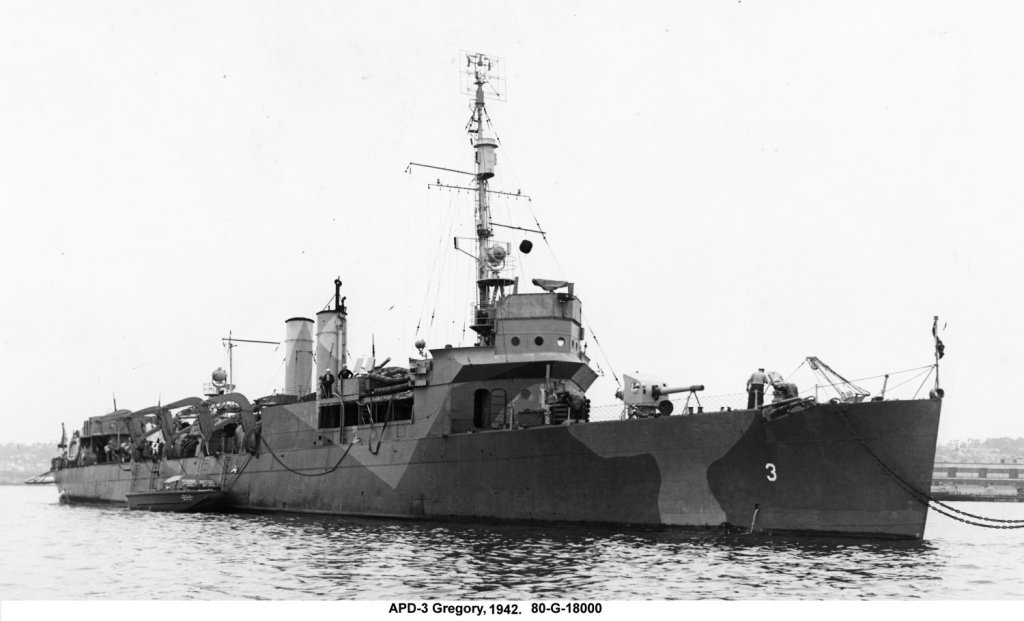
On 4 November 1940, Townsend was part of the commissioning of the converted Destroyer, U. S. S. Gregory (APD-3). While assigned to the U. S. S. Gregory, Townsend completed his training and was promoted to Machinist Mate Second Class, on 31 January 1942. The Gregory then made it’s way to Panama. Passage was made through the Panama Canal on 2 February 1942. The Gregory then arrived in San Diego, on 14 February 1942, where it underwent overhaul. Townsend and the crew of the Gregory trained the 1st Raider Battalion of Marines, off San Clementi, California. Later, the Gregory sailed to Hawaii, arriving at Pearl Harbor on 14 June 1942. After more training, the Gregory then participated in an attack of the Solomon Islands, on 7 August 1942. The Gregory was then sunk on the morning of 5 September 1942, at 01:15, while on submarine patrol. The Gregory had been attacked by three Japanese cruisers and one destroyer. The same day the surviving crew departed aboard the cargo ship William Ward Burrows (AP-6).
On 4 September USS Gregory (APD-3) and USS Little were returning to their anchorage at Tulagi after transferring a Marine Raider Battalion to Savo Island. At 0056 on the morning of 5 September, USS Gregory (APD-3) and USS Little -saw flashes of gunfire which they assumed came from a Japanese submarine until radar showed four targets-apparently a cruiser had joined the three DD’s. A Navy pilot had also seen the gunfire and, assuming it came from a Japanese submarine, dropped a string of five flares almost on top of the two APD’s. USS Gregory (APD-3) and USS Little, silhouetted against the blackness, were spotted immediately by the Japanese destroyers, Who opened fire at 0100. USS Gregory (APD-3) brought all her guns to bear but was desperately overmatched and less than 3 minutes after the fatal flares had been dropped, was dead in the water and beginning to sink. Two boilers had burst and her decks were a mass of flames. At 0123, with all of USS Gregory (APD-3)’s and most of USS Little’s crew in the water, the Japanese Ships began shelling again- aiming not at the crippled ships but at their helpless-crews in the water. All but 11 of USS Gregory (APD-3)’s crew survived, 6 of them swimming through the night all the way to Guadalcanal. USS Gregory (APD-3) sank stern first some 40 minutes after the firing had begun, and was followed 2 hours later by USS Little.
From: Naval History and Heritage Command
Townsend then made his way back to Pearl Harbor, arriving on 28 September 1942. He then was sent to San Diego, arriving on 13 October 1942. He took leave and arrived home in Marion County, on 21 October 1942. While home he married Dorothy (Lyon), on 28 October 1942. He returned off leave 11 November 1942.
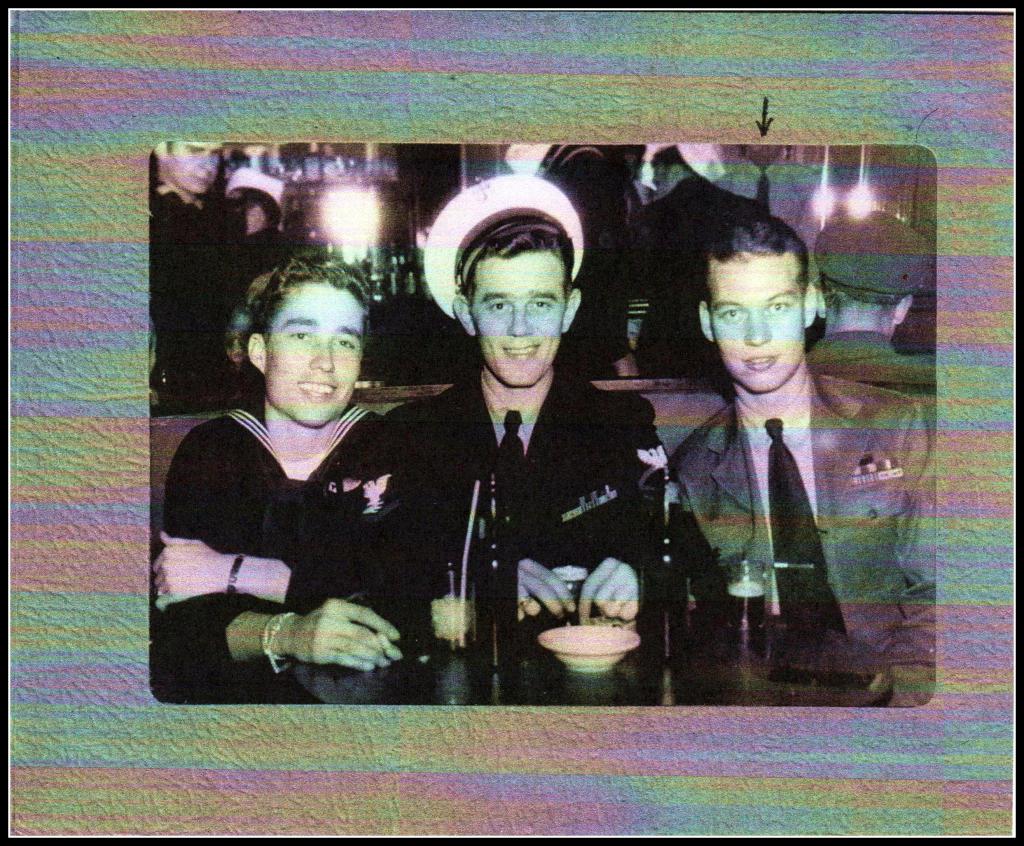
Townsend on Right
Townsend was reassigned to the U. S. S. Stevens (DD-479), on 1 December 1942. On 7 December 1942, he was able to return home again on Christmas leave. His wife, Dorothy was able to accompany him to Charleston. After training and escort cruises aboard the Stevens, they would pass through the Panama Canal and arrive in Pearl Harbor in August of 1943. On 1 September, along with 3 cruisers, 1 battleship, 3 light cruisers, 12 destroyers and one tanker, the Stevens arrived and began bombing the Marshall Islands. On 11 September 1943, they participated in the bombing of Japanese installations on Tarawa Islands. They also participated in bombings on Makin Island. The Stevens crossed the equator on the same date.
Townsend then returned to San Francisco for reassignment to the U. S. S. Cassin Young (DD-793). He then received delayed orders and was sent to Norfolk, Virginia, for engineering school at Naval Training Station, Naval Operating Base (N. O. B.). Upon completion of training, he left on 2 December 1943, for San Pedro, California. There he was back for the commissioning of the U. S. S. Cassin Young (DD-793). The Cassin Young was commissioned on 31 December 1943.
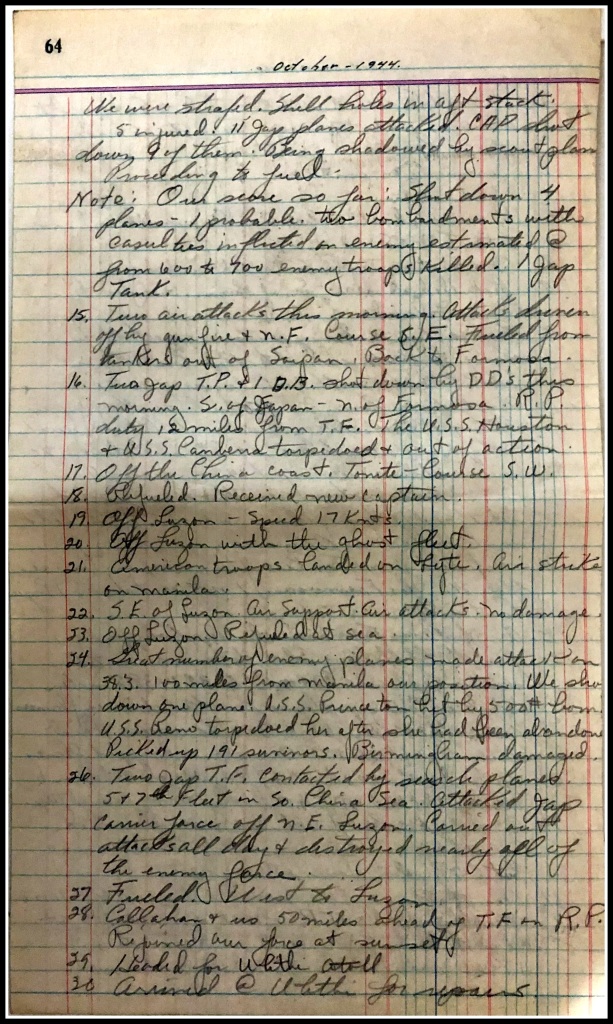
While aboard the Cassin Young, CMM Frank E. Townsend kept his own log of the ship’s operations. He logged the ship’s actions from it’s commissioning until the end of wartime service, 31 August 1945.
Excerpt from Townsend’s Log he kept while aboard the USS Cassin Young Oct. 24, 1944 “Great number of enemy planes made attack on [Task Group] 38.3 100 miles from Manila our position. We shot down one plane. U.S.S. Princeton hit by 500# bomb. U.S.S. Reno torpedoed her after she had been abandoned. Picked up 191 survivors. Birmingham damaged.”
While aboard the Cassin Young, Townsend appears to have lost two of his subordinates. They were killed in action. Townsend passed twice through the Panama Canal, crossed the equator, survived the sinking of the Gregory, survived many enemy attacks and still remembered those he served with by keeping records, photos and stories of their service together.
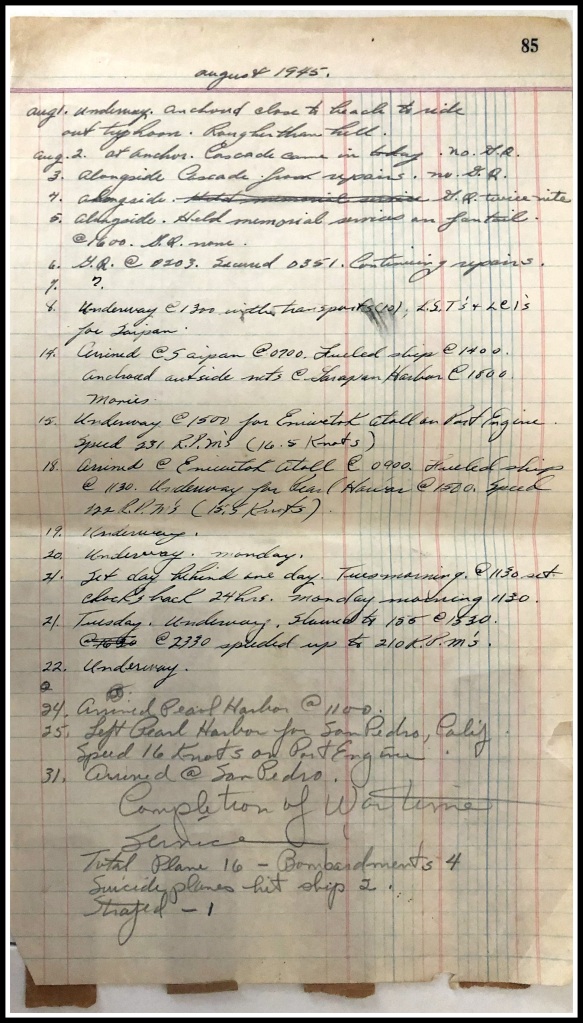
Excerpt of the “end of war” for the USS Cassin Young
“August 21, 1945 Set day behind one day. Tues morning @1130 set clocks back 24hrs. Monday morning 1130. [Crossing the International Date-Line] August 21, 1945 Tuesday Underway. Slowed to 155 @ 1530. @2330 speeded up to 210 R.P.M.S. 22, 1945 Underway 24, 1945 Arrived at Pearl Harbor @1100 25, 1945 Left Pearl Harbor for San Pedro, Calif. Speed 16 knots on Port Engine 31 Arrived @ San Pedro. Completion of Wartime Service Total Plane 16 – Bombardments 4 Suicide planes hit ship 2 Strafed – 1″ Transcribed from Townsend’s own Logs
He attained the rating of Chief Machinist’s Mate. Among his medals were the Asiatic-Pacific Area, 9 Stars; American Area; Good Conduct Medal; European-African Area; Philippine Liberation; American Defense and the Victory Medal World War Two. He was first Honorably Discharged from active service on 5 March 1946.
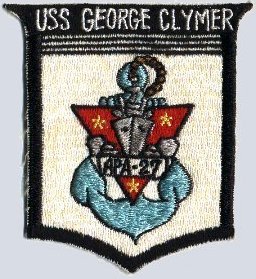
Frank E. Townsend would serve again during the Korean War. He began service on 15 July 1949. He was assigned aboard the U. S. S. George Clymer (AP-57, AP-27). The Clymer participated in the Inchon Landing from 15 – 17 September 1950. The Clymer would participate in other campaigns during the Korean War until July 1953. He was Honorably discharged again on 18 June 1953.
USS George Clymer (AP-57) returned to Inchon 8 October [1950] to embark Marines, and on 17 October she sailed for Wonsan, where she landed troops the 25th. Departing Wonsan 30 October, she steamed via Yokosuka to the United States and arrived San Diego 24 November. From: Naval Heritage and History Command
For his service during the Korean War, MM1C Frank E. Townsend was awarded the following; Korean Service Medal, 3 Stars; United Nations Service Medal; China Service Medal; and the Navy Occupation Medal (Asiatic).
Frank E. Townsend, like many veterans, experienced the loss of many friends. But during his service, he succeeded in military training, rights of passage (passing through the Panama Canal & Crossing the Equator and the International Date-Line), he faced attack by the enemy and participated in bringing the fight to the enemy. These are just some of the experiences that molded the men that were able to return home and make our communities what they are.
Frank E. Townsend returned to Marion and worked with the Ohio American Water Company. He raised his daughters in Green Camp, Ohio. Frank died in 1982, but is still remembered by those he knew and is remembered by his grand daughter, who shared his memories for this article.
Frank E. Townsend’s is remembered for his military service on the World War Two Memorial Wall at the Marion Cemetery
Kenneth Farnum Sweney, Jr. was born on 12 April 1923. His parents are Kenneth F. Sweney, Sr. & Marguerite E. (Wottring). Kenneth, Jr. graduated from Harding High School in 1941. After high school high worked at Weber’s Market. Prior to entering service he was employed by Marion Steam Shovel Company.
Kenneth F. Sweney, Jr. entered service 29 January 1943, Fort Hayes, Columbus, Ohio. He was trained at Keesler Field, Biloxi, Mississippi, and attended Mississippi State College for six months, then went to San Antonio. Sweney opted to become a bombardier, to follow in his brother’s footsteps. It was at San Antonio, that he was Classified as a Bombardier. His brother, Lt. Busby W. Sweney, would be killed in action about three months later.
After being Classified as a bombardier, Sweney became ill. He was diagnosed with acute lymphatic leukemia and hospitalized on 3 August 1943, at Brooks General Hospital, Fort Sam Houston, Texas. His mother, Maggie, was able to be at his side while he was in the hospital. As a current student of the Army Air Corps’ Cadet program, he held the ranking of Aviation Cadet (A/C). Kenneth F. Sweney, Jr. died on 14 September 1943. He is buried in the Sweney Family plot at the Marion Cemetery.
A/C Kenneth F. Sweney, Jr. is remembered on the Honor Roll, at the Veterans Memorial Park, in Marion, Ohio; on the west wall of the Marion County Courthouse; and on the World War II Veterans Memorial Wall, at the Marion Cemetery.
Harley Smith Dodds was born 18 September 1886, in Meeker, Ohio. His parents were Melvin S. & Elizabeth R. (Stout) Dodds.
Private Harley S. Dodds served with Company F, 363rd Infantry, 91st Division, “Wild West Division.” Pvt. Dodds was killed in action near Oycke, Belgium, on 3 November 1918. Pvt. Harley S. Dodds was buried in a temporary military cemetery in Europe. On 6 May 1921, his remains would arrive in Hoboken, New Jersey, aboard the U. S. A. T. Somme. The Somme was a United States Army Transport Funeral Ship returning the fallen to the United States, for final burial. Pvt. Dodds is buried in the Frame Cemetery, Meeker, Ohio.
Private Harley S. Dodds is remembered on the Honor Roll, at the Veterans Memorial Park, in Marion, Ohio; and on the World War One Honor Roll, located on the second floor of the Marion County Courthouse.



 Honoring Marion Ohio Veterans