Floyd Everett Shirk was born on 30 September 1895, in Hepburn, Ohio. His parents are Oliver & Emma Shirk. Floyd E. Floyd E. Shirk served with D Company, 4th Ohio Infantry, Ohio National Guard during the Border Campaign, 1916. While at Camp Willis he was discharged due to a physical disability. Yet, due to his patriotic sense of duty, he continued to make attempts to enter service.
Shirk was accepted into service from LaRue, Ohio, on 29 April 1918. He would go to Camp Sherman, Ohio, for training. At Camp Sherman, he would be assigned to 13th Company, 4th Training Battalion, 158th Depot Brigade until 3 May 1918. Private (Pvt.) Shirk would then be assigned to E Company, 330th Infantry Regiment, 83rd Infantry Division. He would depart New York City, aboard the RMS Carpathia on 12 June 1918, for Europe. Note: the RMS Carpathia would be sunk on 17 July 1918, after being struck by three torpedoes from the German Submarine U-55. On 24 June 1918, Pvt. Shirk was reassigned to L Company, 162nd Infantry Brigade, 81st Infantry Division “Wildcats”. Pvt. Shirk was assigned to the Paris peace conference. He was a guard and cared for the vehicles of President Wilson and other dignitaries. Pvt. Floyd E. Shirk would die of pneumonia on 10 February 1919, in France. Pvt. Shirk was buried in a soldier’s cemetery in Paris, France.
On 6 August 1921, Pvt. Floyd E. Shirk’s remains would depart Antwerp, Belgium, aboard the U. S. A. T. Wheaton. The Wheaton was a United States Army Transport Funeral Ship returning remains of soldiers who died and were buried in Europe. Families could choose to have the remains of their veterans returned for burial in the United States. Pvt. Shirk’s remains would arrive in Hoboken, New Jersey, and then arrive in LaRue, Ohio, on the morning of 3 September 1921. Pvt. Shirk was buried in the LaRue Cemetery, LaRue, Ohio.
Pvt. Floyd E. Shirk is remembered on the Honor Roll, at the Veterans Memorial Park, in Marion, Ohio; and on the World War One Honor Roll, located on the second floor of the Marion County Courthouse.
John Uhl was born 30 September 1884, in Marion, Ohio. His parents are Edward A. & Jennie (Youmans) Uhl. His mother was later remarried and went by Jennie Austin. John Uhl worked as a machinist, with the Marion Steam Shovel Company, prior to entering service. Uhl entered service 29 May 1917. He left with D Company, 166th Infantry Regiment, in August of 1917, for Europe. He would attain the rank of Private First Class (Pfc) on 4 December 1918. He had participated action in the Champagne-Marne; Aisne-Marne; St Mihiel; Meuse-Argonne; Defensive Sector. Pfc. John Uhl would later be part of the Army of Occupation, and be assigned near the Rhine River. He died of bronchial pneumonia on 6 February 1919, in Germany.
JOHN UHL, MEMBER OF D COMPANY, SUCCUMBS
Dies of Bronchial Pneumonia in Germany,, Mother Notified
HIS LAST LETTER TELLS HER NOT TO WORRY
Son of Mrs. Marion M. Austin,, Thirty-Four Years Old and Not Married
Mrs. M.M. Austin of West Columbia Street, received a message this morning from Adjutant General Harris, at Washington, bearing the news of the death of her son, John Uhl, a member of D Company, 166th Infantry. The message stated that young Uhl died February 6 of Bronchial Pneumonia. Earlier this month, Lewis Uhl, a brother of the young man, received a letter from him. The letter was written from somewhere in Germany, he having been with the army of occupation, along the Rhine River. He stated that he was well and told his brother to “tell Mother not to worry.” Among other things he stated that he expected to start home “about February 31.” Young Uhl left home with D Company a year ago last August. he was unmarried and was employed as a machinist at the Marion Steam Shovel Company. He was thirty-four years old in September. Aside from his mother and brother, he leaves one sister, Mrs. Edna Severns, of Bedford
from The Marion Daily Star Feb. 25, 1919
Pfc. John Uhl was first buried in Germany. On 14 June 1920, his remains were disinterred and shipped back to the United States, aboard the transport ship USS Princess Matoika (ID2290). His remains arrived in Hoboken, New Jersey, on 21 July 1920. On the 25th his remains would arrive in Marion, Ohio, for final burial, in the Marion Cemetery. John Uhl is remembered on the Honor Roll, at the Veterans Memorial Park, in Marion, Ohio, and on the World War One Honor Roll, located on the second floor of the Marion County Courthouse.
Ernest Franklin Brown was born on 14 October 1922, in Marion, Ohio. His parents are Ernest A. & Jessie A. (Calvert) Brown, both of Marion, Ohio. Ernest’s father is a veteran of World War One, having been awarded the Silver Star and Purple Heart. Ernest F. Brown was employed with the Huber Manufacturing Company, prior to entering service.
Ernest F. Brown entered service on 18 April 1942, with the United States Naval Reserves. Brown took his training at the Great Lakes Naval Training Station, Illinois. He attained the rank of Seaman Second Class (S2C).
Brown was assigned as a radio operator aboard the U. S. Destroyer De Haven (DD-469). The USS De Haven departed Norfolk, Virginia, for the South Pacific on 8 November 1942. The De Haven arrived at Guadalcanal on 7 December 1942. The De Haven was assigned to escort duty, making several voyages between Guadalcanal and Espiritu Santo. She was assigned to Task Group 67.5 on 20 January 1943.
The following is an account of the combat actions of 1 February 1943, in which the Destroyer DeHaven wasscreening six LCT’s and a seaplane tender that were establishing a beachhead at Marovo on Guadalcanal. While escorting two of the landing craft back to their base in the afternoon, De Haven was warned of an impending air attack. She sighted nine unidentified planes and opened fire as six swung sharply toward her. She splashed three of these planes, but not before all six had dropped their bombs.
At about 1457, a swarm of 14 aircraft was sighted off DeHaven’s starboard beam at a distance of 25,000 yards. At first, it appeared as though the enemy had not seen the tiny convoy and, for a time, the aircraft remained on their original course. Then, suddenly, six aircraft broke away from the formation and streaked toward the destroyers and their charges. DeHaven’s guns, as well as Nicholas’ and those on the landing craft, opened up. Fiery tracers stabbed into the oncoming flock, with bursts of flak blossoming about the planes. Three of the aircraft were sent spiraling in flames into the sea. The remaining three bolted through the heavy mantle of flak and AA fire and, for some reason, singled out DeHaven as their choice target. The 469 off Savo Island; Four bombs plunged down upon the destroyer, one of which struck the bridge, killing and wounding all personnel within the structure. Lying dead among the ruins was her captain, Commander Charles E. Tolman. Two bombs smashed on her bow and another exploded below her waterline, splitting open her hull plating. Severely crippled, DeHaven lost all power, came to a halt and began to settle swiftly by the bow. Five minutes after the last bomb had hit, the destroyer’s bow was well under, her stern high out of the water. Ensign C. L. Williams, the only officer who was not wounded, realized that DeHaven was going down and passed the word to abandon ship. While the personnel below decks were scrambling to escape from out of the topsy-turvy hell in the lower compartments, DeHaven suddenly upended and plunged to her watery grave, taking 167 members of her crew down with her, to rest forever on the floor of “Iron Bottom Sound.”
From Blood on the Sea-American Destroyers Lost in World War II by Robert Sinclair Parkin.
Since S2C Ernest F. Brown was working as a radio operator, he was likely working on the bridge when the Japanese dive bombers made a direct hit to the bridge. It was reported all crew on the bridge were killed at that time. In February of 1943, his family was notified that he was Missing in Action. It was not until 2 April 1944, that he and others missing from the crew, were officially declared dead.
S2C Ernest F. Brown’s remains were not recovered. His name appears on the Walls of the Missing, Manila American Cemetery and Memorial, Manila, Philippines. S2C Ernest F. Brown is remembered on the Honor Roll, at the Veterans Memorial Park, in Marion, Ohio; on the west wall of the Marion County Courthouse; and on the World War II Veterans Memorial Wall, at the Marion Cemetery.
U. S. Destroyer DeHaven (DD-469), just day prior to her final actions.
Robert Joseph Brown was born on 4 August 1922, in Marion, Ohio. His parents are William S. & Opal M. Brown. Robert was employed at the Huber Manufacturing Company, prior to enlisting into the United States Naval Reserves.
Robert J. Brown attained the rank of Ship’s Cook First Class (SC1c). He served aboard the Submarine U. S. S. Swordfish (SS-193). The Swordfish departed Pearl Harbor on 22 December 1944, to patrol the Okinawa area. It stopped at Midway Island for fuel on 26 December 1944. The last communications from the Swordfish was on 3 January 1945. The Swordfish was expected to arrive in Saipan on or about 29 January 1945. The Swordfish did not arrive and no further communication was received. She was thought to have been in the area that was mined and also had Japanese depth charges being detonated. The Swordfish crew was reported as Missing in Action, on 29 January 1945.
SWORDFISH, under Cdr. K. E. Montross, left Pearl Harbor on 22 December 1944, to carry on her thirteenth patrol in the vicinity of Nansei Shoto. She topped off with fuel at Midway on 26 December and left that day for her area. In addition to her regular patrol, SWORDFISH was to conduct photographic reconnaissance of Okinawa, for preparation of the Okinawa Campaign. On 2 January, SWORDFISH was ordered to delay carrying out her assigned tasks in order to keep her clear of the Nansei Shoto area until completion of carrier based air strikes, which were scheduled. She was directed to patrol the general vicinity of 30° 00’N, 132° 00’E until further orders were received. In the last communication received from SWORDFISH, she acknowledged receipt of these orders on 3 January. On 9 January 1945, SWORDFISH was directed to proceed to the vicinity of Okinawa to carry out her special mission. It was estimated that the task would not take more than seven days after arrival on station, which she should have reached on 11 January. Upon completion of her mission, SWORDFISH was to proceed to Saipan, or to Midway if she was unable to transmit by radio. Since neither place had seen her by 15 February, and repeated attempts to raise her by radio had failed, she was reported as presumed lost on that date. In the report of her loss, mention was made that KETE, which at the time was patrolling the vicinity of Okinawa, reported that on the morning of 12 January she contacted a submarine by radar. It was believed that contact was with SWORDFISH since it was in 27° 00’N, 128° 40’E. Four hours later KETE heard heavy depth charging from this area and it was believed that this attack might have been the cause of SWORDFISH’s loss.
Compiled by Paul W. Wittmer and Charles R. Hinman, originally from: U.S. Submarine Losses World War II, NAVPERS 15,784, 1949 ISSUE
The Swordfish’s (SS-193) crew pose with the ship’s battle-flag crediting her with 20 sinkings.
SC1c Robert J. Brown was MIA – presumed dead with crew, near Yaku Island, off Kyushu, Japan. The official date of death for the crew is 12 January 1945. SC1c Robert J. Brown is remembered on the Honor Roll, at the Veterans Memorial Park, in Marion, Ohio; on the west wall of the Marion County Courthouse; and on the World War II Veterans Memorial Wall, at the Marion Cemetery.
There is also a Memorial in St. Paul, Minnesota, honoring the crew of the U. S. S. Swordfish (SS-193). It has a plaque with the names of the crew members lost at sea. Robert J. Brown’s name is among those brave men listed.
Memorial to Swordfish (SS-193) at St. Paul, Minnesota, dedicated in January 1967. It features a torpedo and has plaques on either side, one in memory of Swordfish crewmen lost with their submarine off Okinawa, in January 1945. The other plaque memorializes the fifty-one other U.S. Navy submarines lost during World War II. The memorial was financed and built by the City Council, Minnesota Building Tradesmen and the Minnesota Viking Squadron of the U.S. Submarine Veterans of World War II.
Memorial to Swordfish (SS-193) at St. Paul, Minnesota
The plaque on the “Swordfish Memorial” reads: “THE U.S. SUBMARINE VETERANS OF WORLD WAR II, MINNESOTA VIKING SQUADRON PROUDLY DEDICATES THIS MEMORIAL TO THE VALIANT MEN OF THE U.S.S. SWORDFISH SS193 SUNK BY ENEMY ACTION ON HER 13TH WAR PATROL ON JANUARY 12, 1945 AFTER SINKING 12 ENEMY SHIPS FOR A TOTAL OF 47,926 TONS COMMANDER K. E. MONTROSS, COMMANDING OFFICER
CREW OF THE U.S.S. SWORDFISH – (SS-193) (Crews names listed on the memorial plaque)
Kathleen Brammer of Marion, Ohio, follows in her family’s standing tradition of military service to country. Her grandfather served in the Army Air Corps and later as a civilian contractor, her grandmother served in the Royal Canadian Air Force, her mother served in the United States Air Force, and her father served in the United States Navy. Kathleen is one of four siblings to serve in the armed forces; she has a brother, who served in both the U. S. Navy and U. S. Army; another brother who served in the U. S. Army; and a sister who served in the U. S. Air Force.
Brammer attended Pleasant High School and transferred to Harding High School for her senior year. While at both Pleasant and Harding, Brammer was part of the marching band’s color guard. During high school, Brammer would also attend Tri-Rivers Career Center, in the Cosmetology program, gaining her Esthetician certification. She was also trained in first aide and CPR. After graduation she decided to follow in her families tradition of military service, by enlisting into the United States Army.
Kathleen Brammer started her basic training at Fort Jackson, South Carolina, in early 2020. She would be one of the first groups of trainees to train during the COVID-19 Pandemic. In the midst of training the armed forces as well as the rest of the world, would have to begin transitioning into the new and sometimes challenging, COVID precautions era.
When asked how did COVID affect you, she said, “Covid affected basically everything. Our families weren’t allowed to see us graduate either BCT (basic training) or AIT (advanced individual training). I didn’t see my family until I took leave a few months into being in Korea.” She also added, “Masking became routine. It was strange coming back and seeing people not wearing them. And there is a mandatory quarantine of 2 weeks when flying from the US to Korea. I didn’t mind it too much. It was fun, depending on the roommates.”
Brammer said she was able to write and receive letters while in basic training. She said they still used pen and paper, something that may have been foreign to the newer generation. But, mail call has been a lasting and ever cherished event in military service. She also shared that they were allowed 5 minute phone calls as they neared the end of the training cycle. This seems very much unchanged from when the author attended basic training over thirty years ago. Also, similar to past Fort Jackson veterans, she said she had to march and countermarch “Tank Hill.” And she said that she very much “hated it.” Another enduring part of training was the gas chamber and Victory Tower. Brammer said that she was very afraid of heights and the Drill Instructor (DI) could see it on her face. When she was getting in position at the edge of the tower, prepping for her repell, the DI put his boot on her shoulder as if to kick her off “his tower!” Brammer said she completed the confidence training at Victory Tower and would see the real life confidence she gained, while later at her permanent duty station.
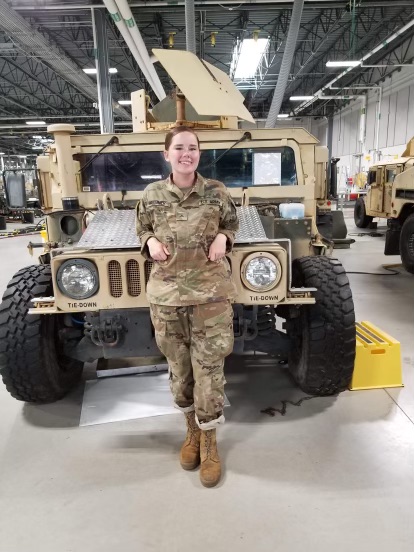
After successfully completing basic training, Brammer would go on to Fort Lee, Virginia, for Advanced Individual Training (AIT). She would be trained as a 91-C “Utilities Repairer/HVAC Technician.” Brammer has memories of her and fellow trainees going to the Post Exchange (PX) to get snacks, which were not allowed in the rooms of trainees. They would buy the snacks and hide them all around their waistbands to get them into the quarters for a movie night. A little team building exercise.
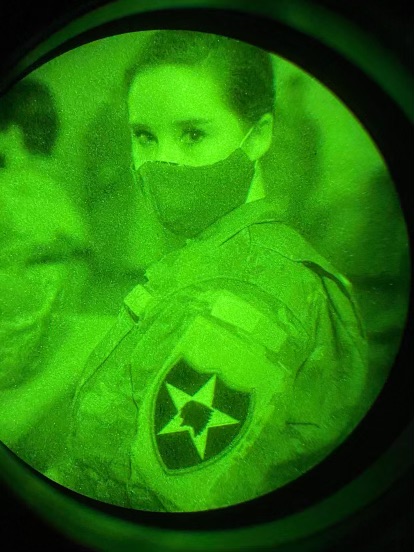
After graduating from AIT, Brammer would be assigned to the 2nd Infantry Division “Second to None.” She was sent to her unit in South Korea. In Korea Brammer was promoted to the rank of Private First Class (Pfc.). This was her first experience outside of the United States. She would also have to learn to speak Korean, in order to get around; another first for her.
Pfc. Kathleen Brammer would get to use her new job skills while in real duty situations. She has earned the Army Achievement Medal and multiple Certificates of Recognition, for her successful task completions. One that she shared was when she was able to make repairs needed to a medical vehicle. The vehicle was in need of heating and air conditioning repairs. She had to use her skills to not only trouble-shoot the multiple problems, but had to improvise in making the repairs. She said she had to literally, “use my teeth to get the job done.” Thus, the medical vehicle and team were able to complete its mission. Pfc. Brammer was able to remain proficient in her skills, taught by the army, to help keep her unit “mission ready.”
Second Infantry Division Mission: The 2nd Infantry Division is the last remaining permanently forward-stationed division in the U.S. Army. The 2nd Infantry Division deters aggression and maintains peace on the Korean Peninsula; and if deterrence fails, “Fight Tonight” in support of the U.S-Republic of Korea Alliance.
From the 2nd INFANTRY DIVISION Page
Pfc. Brammer found that Korea was not as bad as many had said it would be. She said that duty revolved around many drills and real alerts. These drills were to maintain combat readiness. These alerts consisted of much readiness exercises and standing in the old “hurry-up-and-wait” actions. Author’s Note: South Korea is not a typical duty station. For several decades our military has been ready for a quick response to hostile actions from North Korea. It remains a real world hot spot and much posturing goes on to this day.
While in Korea, she enjoyed down time with fellow soldiers at the post bowling alley. She was also able to get off post, and into the civilian area and experience Korea. She would go sightseeing and even went bungee jumping, something she may never have attempted, had she not conquered some fears back at Fort Jackson’s Victory Tower.
Brammer says that she enjoyed the trips to Nami Island, which is near Seoul, South Korea. She stated that this island was very cultural and beautiful. The island has many tree lined paths and is known as a set for many movies. Brammer shared that, “Nami Island is a cultural area. With lots of museums, along with opportunities such as zip-lining, bungee jumping, and ATV riding. Brammer also said she enjoyed trying the local cuisine. She said, “The Korean food was amazing, although most things are much spicier than I expected.”
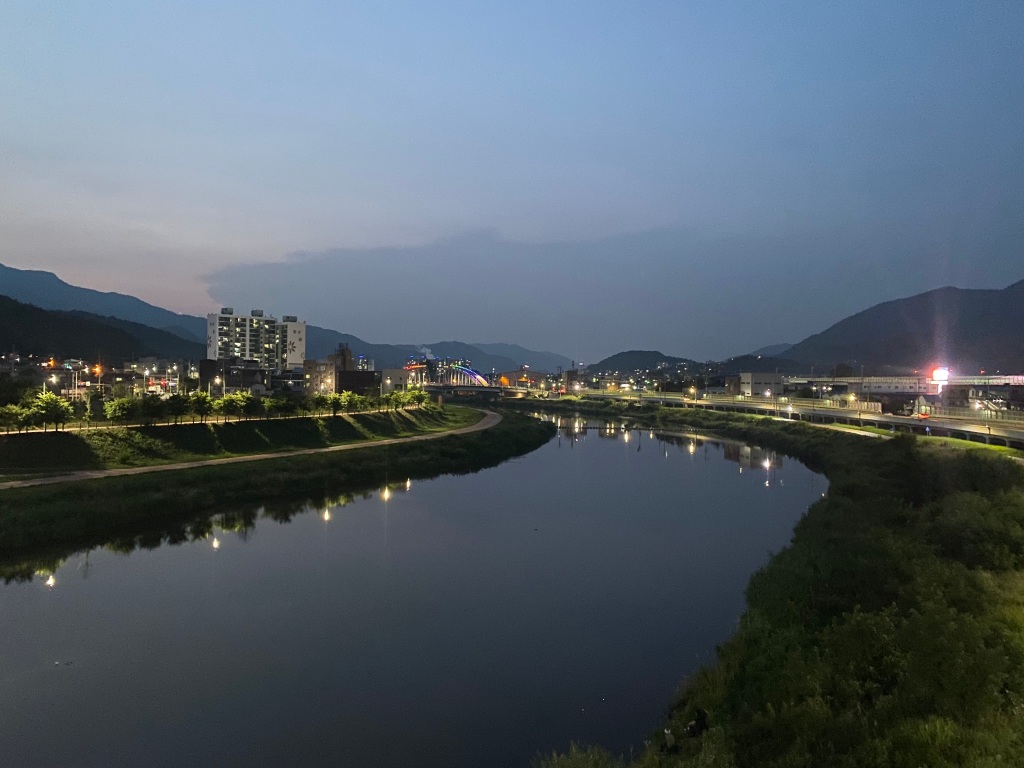
Korean Night Scene. Photo by K. Brammer
While in Korea, Brammer did get to see a fellow classmate also serving in the army. She was able to spend a brief visit with former Pleasant classmate. She also was able to have lunch with a couple of service members from Mt. Gilead and Columbus, Ohio. Social media, not available to many veterans of old, is a nice way for service members to keep in touch with friends and family and to learn if they are nearby.
So far, Brammer feels the military has helped her by challenging her both mentally and physically. She has been able to do tasks she would not otherwise have attempted. Now she feels she can better push herself to succeed in life in general. While in training, she wrote a note in her journal to herself. It was there to remind her of when things got tough to continue forward. It read, “Keep pushing. Even if you want to quit, just remind yourself why you came here. You’re stronger than you think you are.” She would remember the motivating quote throughout and always recalls it during challenging times.
Pfc. Brammer has some post-military goals. She hopes to return to school and get a degree in art and maybe become an art teacher. She even has ideas to become trained and work as an Emergency Medical Technician, to help get her through her schooling.
We thank Pfc. Brammer and her family who raised her in the tradition of service. Female veterans and service members are under-recognized on this blog, but their service is not forgotten and is very much appreciated.


 Honoring Marion Ohio Veterans