Robert Abrams – Korean War & Vietnam Veteran

Robert Abrams was a Marion resident before entering service. He comes from a veteran-proud family. He had two uncles who served in the military and he had three brothers and a sister who served in the military as well as cousins and nephews. His older brother, Alva, served as a gunner on a B-17 in the Pacific theater during World War Two; his brother, Ronald, served in the infantry during the Korean War; another brother, Martin, served as a quartermaster; and his sister, Rachel, served in the Finance Corps. Robert said he followed in his brother’s, Alva’s, footsteps and joined the Army.
Robert Abrams graduated from Harding High School with the Class of 1952. For a short time he worked for Western Union. In September of 1952 Robert joined the United States Army and attended basic training with the 3rd Armored Division at Fort Knox, Kentucky. He would continue his training and become a Combat Medic at the Heath Services Command, Fort Sam Houston, Texas.
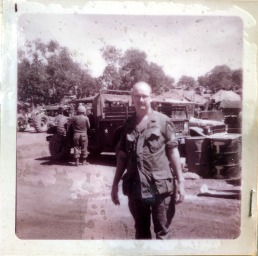
IMG_5311Abrams would spend a career in the Army; serving in Korea War from 1952-1953, as an ambulance driver with the 24th Medical Battalion; he then would served time in Germany with the 30th Medical Battalion; he also would serve two tours in Vietnam with the 1st Cavalry Division “First Team.” He also would serve time in the states at various posts.
While in Vietnam he was serving with HQ 8th Engineers and the 15th Medical Battalion. He spent time in Vietnam at LZ English, Phu Cat Airbase, as well as other locations. He would work as a medic running on ambulance, hospital duty and serving on medevac helicopters.
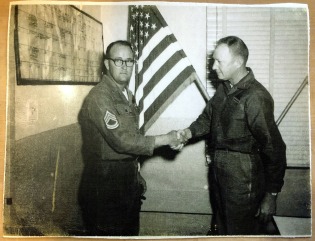
IMG_5309Abrams remembers a time when he was on patrol in Vietnam and they came under attack from across the river when they were in the delta area. He said lots of small arms fire was coming in at them and he was with a mortarman. The soldier asked, “Sarge do you know how to fire mortar rounds?” Abrams said, “No, but I bet I can figure it out.” Abrams said the mortarman would set up the tube, set the fuse on the mortar and hand them to Abrams. Abrams would then drop them in the tube to fire. He said after a while of doing this he heard someone calling him on the PRC radio. It was an Australian pilot asking, “Do you Yanks need some help down there?” Abrams answered, “Yes, all that you can give us.” The pilot then asked where Abrams wanted the fire. The mortarman set up a smoke round and Abrams put it on the enemy position. The Aussie pilot them commenced gun and rocket runs on the enemy positions. When the pilot was empty he radioed back saying, “Anytime you Yanks need some help, give me a call.”
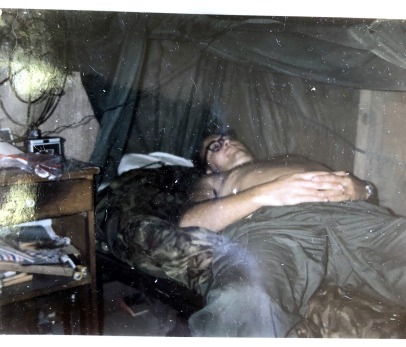
IMG_5313
Abrams personal area in Vietnam

Abrams said he later found out that it was estimated a thousand enemy were across the river firing on them. He said he was awarded the Army Commendation Medal with a V-device for that action. Abrams said he had no idea there were that many enemy and laughingly said he probably would not have stuck around if he did know.
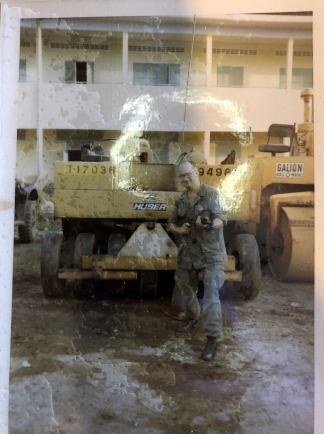
IMG_5317
Abrams recognized this equipment in Vietnam as being manufactured in his hometown, Marion, Ohio.

Abrams also recalls a time in Vietnam when a Vietnamese interpreter called him out of the ward and said a Vietnamese girl was outside and wanted to speak with him. Abrams said he told the interpreter that he didn’t know any Vietnamese girls. When he went outside, he found the Vietnamese was a girl whom he had helped save her life. She had lost here hand and Abrams had worked on her. She came to thank him.
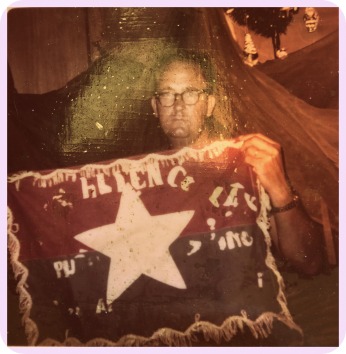
IMG_5314
Flag that Abrams took from a North Vietnamese Soldier.

Abrams was awarded the Silver Star, Bronze Star Medal as well as other awards in his military career. He would retire as a Sergeant Major.
Abrams says he wishes he was able to stay in touch with guys he served with over the years. He had lost touch with many of them. A few did write to him. He has one friend who sends him a Christmas card from St. Louis every year.
After returning to Marion, Ohio, Abrams worked at the Marion Correctional Institute for another 25 years before again retiring. He keeps busy now helping other veterans in need of assistance with veteran’s benefits. He enjoys talking about his family and military career. He still resides in Marion, Ohio, with his wife, Joyce. Abrams also has two sons, whom he and his wife raised on various Army installations. Both sons, Paul and Michael are veterans of the army Reserves.

Pvt. Joel H. Buchanan – Korean War Casualty

Joel Harold Buchanan was born 9 December 1932.
Pvt. Joel H. Buchanan was killed in Korea on 16 July 1950. Pvt. Buchanan was serving with the 19th Infantry Regiment, 24th Infantry Division, in Korea when he was killed in action. Among Pvt. Buchanan’s awards were the Purple Heart, the Combat Infantryman Badge, the Korean Service Medal, the United Nations Service Medal, the National Defense Service Medal, the Korean Presidential Unit Citation and the Republic of Korea War Service Medal.

Pvt. Joel H. Buchanan is buried in the Marion Cemetery and is remembered on the Honor Roll, at the Marion Veterans Memorial Park in Marion, Ohio; and on the west wall of the Marion County Courthouse.

David W. Pierce – Vietnam Casualty

David Wayne Pierce son of James & Mary Linn Pierce; and brother of John Pierce was killed by friendly fire in Dinh Tuong Province, South Vietnam. Pierce was a 1967 graduate of Harding High School. Before his enlistment, David was working at Quaker Oats Company. Pierce enlisted in the Army on 12 February 1968. Pierce arrived in Vietnam in September of 1967. When he arrived in Vietnam his brother, John, was serving in the same unit that David would be assigned. John Pierce was already discharged at the time of David’s death.
Pierce01Pfc. David W. Pierce was killed during hostile action on 13 December 1968. Pierce was serving as an artilleryman with C Battery, 1st Battalion, 11th Field Artillery, 9th Infantry Division “Old Reliables.” As he was moving to his position, he was thought to be part of an enemy force. He was then killed by fratricide.
Private First Class David W. Pierce is buried in the Marion Cemetery, Marion, Ohio; and is remembered on the Honor Roll, at the Marion Veterans Memorial Park in Marion, Ohio; on the west wall of the Marion County Courthouse; at the Marion County Admin building at 222 West Center St. in Marion, Ohio, and at the Vietnam Veterans Memorial Wall in Washington, D. C. on Panel W36 Line 18.

George B. Christian, Sr. – Civil War Veteran

George B. Christian, Sr., grandfather of Warren Wilson Christian, was a businessman in Marion, Ohio. He served in the Union Army as a young man. Later Christian became friends with Warren G. Harding.

George Busby Christian, Sr. was born 27 December 1846. He served during the Civil War and attained the rank of Private First Class. It is not known how or why, but he came to be known as “Colonel Christian.” During his enlistment he served with B Company, 5th Independent Battalion, Ohio Volunteer Cavalry. Christian was a charter member of Cooper Post; No., 117, G. A. R. After returning he would teach in the schools of Green Camp.
Christian would marry Lydia Ellen Morris on 14 October 1869. Together they would have three children; George B. Christian, Jr., Mary B. (Christian) Dombaugh, and Alice M. (Christian) Roberts.
George B. Christian, Sr. would serve as county auditor and county surveyor. He also did some work in the lumber business and later would be the owner and editor of the Marion Mirror Newspaper.
George B. Christian, Sr. would die on 19 September 1930. George B. Christian, Sr. is buried in the Marion Cemetery.

George B. Christian, Sr. is remembered on the wall of the Soldiers and Sailors Chapel, Column 60, at the Marion Cemetery, Marion, Ohio.

Obituary George B. Christian, Sr.

Col. George B. Christian, 83, father of George B. Christian, Jr., former secretary to President Harding, died Monday at 3:40 a. m. at his home in Marion. The death of Col. Christian marks another step in the passing of the old regime of Marion County.
Colonel Christian was a familiar figure in all the phases of Marion life. With the exception of short intervals of travel and his service in the Civil war, he spent 83 years in Marion and in Marion county.
When the ranks of the Union army were opened to youths of 18 and under in 1863 Mr. Christian enlisted with Co. B. independent battalion, Ohio Volunteer Calvary. He served in the Kentucky mountains, engaging in fights and guerrilla forces. He was a charter member of Cooper Post; No., 117, G. A. R.
Colonel Christian was influential in the development of a lime and stone quarry industry in Marion and nearby counties.
Shortly after his marriage on Oct. 14, 1869, near Green Camp, to Lydia Ellen Morris, he became deputy county auditor under the late Richard Wilson. Before his marriage he was a teacher in the Green Camp schools.
Later he engaged in the lumber business and made his home in Pleasant Township.
In 1872, he was elected county surveyor and served in that capacity for three years. He went abroad in 1876 and upon his return in 1877, became editor and proprietor of the Marion Mirror.
Col. Christian was the oldest living member of Marion Lodge No. 70, Free and Accepted Masons.
Besides his son, George Jr., Col. Christian is survived by two daughters, Mrs. J. F. Dombaugh and Mrs. Chester C. Roberts of Marion, three sisters, Mrs. Carrie Garberson, and Misses Hattie and Bernice Christian, of Marion. Six grandchildren are living. A brother, Norris Christian, and a sister, Mrs. Frank Kent, preceded him in death.
Funeral services were held Wednesday at 2:30 p.m. at the Christian home, with Rev. Howard L. Olewiler, pastor of First Presbyterian church and the G. A. R. corps officiating. Interment was made in the Marion Cemetery.

From A Conspicuous Life: George B. Christian Sr. and the Rise of Industrial Marion by Joel Miyasaki

A Conspicuous Life traces George B. Christian Sr.’s (1846-1930) story and the growth of the city he loved. Born in Marion, Ohio, Christian was only a boy when he volunteered in the Union Army during the Civil War. Later he served as an editor of one of Marion’s most important newspapers, the Marion Democratic Mirror. For forty years he worked as a prominent leader in the lime and stone industry, running quarries in Marion and Delaware Counties. Christian was a friend and neighbor of President Warren G. Harding. He helped the future president learn the newspaper business and encouraged his political ambitions. Christian’s son served as Harding’s personal secretary in the White House. Christian eventually defended Harding’s memory as scandal threatened to tarnish the fallen president’s legacy. Miyasaki’s biography not only tells the story of the man, but seamlessly contextualizes the events from his life into the larger history of the Marion, Ohio, and the nation.

George B. Christian, Jr.

George Busby Christian, Jr. was born 25 March 1873, in Marion, Ohio. George B. Christian, Jr.’s father spent much time with Warren G. Harding and some photos show George Jr. as a child playing at the Harding’s residence. Christian would graduate from Marion High School in three years as he was a gifted student. He then would attend the Pennsylvania Military College. Here he would graduate with a degree in Civil Engineering. It does not appear that George Jr. served in the armed forces. He worked for a time with George Sr. at his father’s company, Norris & Christian Stone and Lime Company.
George B. Christian, Jr. would marry Stella Farrar in 1898 and they would have two sons, Warren Wilson Christian (b. 1898) and John Farrar Christian (b. 1900).
In 1913, when Warren G. Harding ran for U.S. Senate, Harding made George B. Christian Jr. is personal secretary. When Harding became president he kept Christian on as his Secretary to the President.
George B. Christian, Jr. died 9 February 1951. And is buried in the Marion Cemetery.

The following article is from Pennsylvania Military College Hall of Legends:

George B. Christian, Jr., 1896 (White House Insider)

After completing high school in three years, George B. Christian, Jr., left Marion Ohio and enrolled at Pennsylvania Military College. He was a gifted student, earning the title of distinguished Cadet for earning a spot on the Merit List. Colonel Frank Hyatt wrote that “Mr. Christian is a cadet of high character and excellent intellectual attainments.” In 1896, he graduated with a Civil Engineering degree. He then returned to Marion and worked for his father at the Norris & Christian Stone and Lime Company.

Christian was also the next-door neighbor of Warren and Florence Harding. At an early age he delivered the Star newspaper, owned and operated by Harding. When Harding ran for the U.S. Senate in 1913, Christian was very involved in the campaign. One of the first decisions Harding made as senator-elect was to hire Christian as his personal secretary. As Harding’s alter ego this association continued throughout Harding’s presidency.

As Secretary to the President, Christian was the precursor of today’s White House Chief of Staff. He would act as the buffer between the President and public, keeping the President’s schedules and appointments, managing his correspondence, communicating to the press and managing the White House staff, which consisted of 31 people during the Harding Presidency.

President Harding February, 1920, PMC (Pennsylvania Military College) held its annual recognition of Washington’s birthday. Then Senator Harding, accompanied by Christian, was the featured speaker and was awarded the degree of Doctor of Laws. Harding’s address was described as a “tribute to PMC.” Although Harding declined an invitation to attend the Centennial Commencement Ceremony, Christian sent a photo of the President inscribed with the comment “… from one who holds Chester’s famous college in high esteem.”

Christian was devastated after the unexpected death of Harding in 1923. In an interview with the New York Times he commented: “For nearly nine years I worked beside him and my present sorrow is somewhat assuaged by the feeling of satisfaction of having been permitted to serve a great president, a most humane and considerate chief and the finest friend as has ever been given a man to have.” Although he assisted with the transition of President Coolidge, Christian turned down the President’s offer to remain.

For the next few years, Christian devoted his time to working with the Harding Memorial Association, which was formed shortly after Harding’s death to plan and raise money for the Harding Memorial. He had also planned on writing a biography about Harding and his own experiences, but he developed glaucoma, with eventually robbed him of his sight. By 1930 he was inactive and his health began to fail. died in 1951.