Commander Bruce Nystrom Missing in Action, Vietnam, December 2, 1966

IMG_3831
Nystrom is the center left photo

Bruce August Nystrom was born in Marion, Ohio, October 18, 1927, the son of the late Mr. and Mrs. U. A. Nystrom. Bruce graduated from Harding High School in 1945. While at Harding High School, Bruce participated in the senior chorus, played football, and met his sweetheart/future wife, Nancy (Nicoll). Bruce Nystrom was also a graduate of Stanford University.

Bruce A. Nystrom entered active duty service on 1 July 1945. He was He was part of the Navy reserves at Denison University, in the V-5 Aviation Cadet Program. He later transferred to Union College, in New York. On 13 August 1948 he earned the Naval Aviator Wings after completion of flight training and the Aviation Midshipman program.

Bruce Nystrom served as an aviator for the United States Navy. Commander Nystrom was a veteran of the Korean war, where he flew 63 combat missions. Nystrom later served in the Vietnam War flying over 50 combat missions. On December 2, 1966, while serving on the USS Franklin D. Roosevelt (CVA-42), he was shoot down over Vietnam. Nystrom was due to return home a month after he was shot down. Nystrom commanded the Blue Bolt Squadron on the aircraft carrier USS Franklin D. Roosevelt (CVA-42). He and his wing-man, Lt Paul Worrell were declared missing in action near Hanoi in North Vietnam. Although Worrell’s remains were later returned in 1985, Nystom’s body was never returned or accounted for. He was declared “Presumed Dead” by the Department of the Navy in 1978.
Both his parents and his wife, Nancy, advocated for the return of those lost in Vietnam until their deaths. Nancy traveled to the Paris Peace Talks on Christmas day with 148 other Americans trying to find information on fathers and husbands missing in action. They submitted names to the North Vietnamese Delegation in hopes that information would be later released. Sadly, Bruce Nystrom’s parents and wife died with no word on the status of Commander Nystrom.

A-4C_VA-172_on_USS_FDR_off_Vietnam_1966
The A4C Skyhawk

The following is from The Brown Shoes Project

Bruce August Nystrom enlisted in the Navy under the V-5 Aviation Cadet Program. He was ordered to active duty on 1 July 1945, and reported to the V-12 units at Denison University in Ohio, later to Union College, Schenectady, New York. He was designated a Naval Aviator on 13 August 1948, following successive phases of flight training as an Aviation Cadet and Aviation Midshipman.
After joining VF-153, flying the F8F “Bearcat”, he was commissioned on 21 January 1949. As a member of VF-193, aboard the USS Princeton, he participated in the Korean War, flying F4U “Corsairs” and also served as squadron Air Intelligence Officer.
In July 1945, LTjg Nystrom received orders to the Naval Air Basic Training Command in Pensacola, Florida, where he served as a tactics and gunnery flight instructor until September 1953. The following three years he flew the F2H “Banshee” in VF-82 at Oceana, Virginia, was promoted to Lieutenant, and made cruises to the Mediterranean aboard the carriers Lake Champlain (CV-37) and Intrepid (CV-11) as squadron Administrative Officer.
He graduated from Stanford University in April 1958 with a B.S. degree in Engineering. The next two and a half years he was the Operations Officer at the Douglas Aircraft’s Palmdale, California, Facility working for the BuWepsRep El Segundo on the A4 “Skyhawk” program.
From November 1960 until July 1962, LCDR Nystrom served as the Aide/Flag Lieutenant for Commander Alaskan Sea Frontier at Kodiak, Alaska. He then attended the Command and Staff Course, Naval War College. Upon graduation, he underwent A4 training at VA-44 and was the Air Wing Three Operations Officer from December 1963, to December 1964, when he joined VA-172 as Executive officer. He was based at NAS Cecil Field, Florida.
December 23, 1965, Commander Nystrom assumed command of VA-172. He deployed with his squadron for Vietnam aboard the USS Franklin D. Roosevelt (CVA-42) June 21, 1966. On December 2, 1966, while flying a mission over North Vietnam south of Hanoi in the Red River delta, Commander Nystrom and his wing-man, LT Paul Worrell, disappeared.

Commander Nystrom was selected for promotion to Captain in August 1969.
The Department of the Navy made a Presumptive Finding of Death for Captain Nystrom 8 August 1978 with no further information having been provided by North Vietnam. Blanket presumptive findings of death for POW/MIA were begun in 1977 authorized by President Jimmy Carter due solely to passage of time.

Captain Nystrom holds the Distinguished Flying Cross, Bronze Star with Combat “V”, Air Medal with 8 gold stars, Navy Commendation Medal with Combat “V”, gold star in lieu of 2nd Navy Commendation Medal, Korean Presidential Unit Citation, Purple Heart, Navy Unit Commendation, Navy Occupation Service Medal, plus other unit citations and awards. Also, Republic of Vietnam awarded its Air Gallantry Medal with Silver Wings.
Captain Nystrom’s wife, Nancy died on July 15, 2012, and their children, Andria Nystrom Dostaler, Gregory, and Diane Nystrom Douglas and five (5) grandchildren still await a final accounting of his fate. Bruce’s father died in 1972. His mother died in 1987. He was an only child.

Nystromfamily

The following is a report from Task Force Omega

Name: Bruce August Nystrom
Rank/Branch: Captain/US Navy
Unit: Attack Squadron 172
USS Franklin D. Roosevelt (CVA-42)
Date of Birth: 18 October 1927
Home of Record: Marion, OH
Date of Loss: 02 December 1966
Country of Loss: North Vietnam
Loss Coordinates: 200500N 1061200E (XH254209)
Status in 1973: Missing In Action
Category: 2
Aircraft/Vehicle/Ground: A4C “Skyhawk”
Other Personnel in Incident: Paul L. Worrell (remains returned)
REMARKS: POSS DEAD – IR 6918571875

SYNOPSIS: The Douglas A4 Skyhawk was a single-seat light attack jet flown by both land-based and carrier squadrons, and was the US Navy’s standard light attack aircraft at the outset of the war. It was the only carrier-based aircraft that did not have folding wings as well as the only one which required a ladder for the pilot to enter/exit the cockpit. The Skyhawk was used to fly a wide range of missions throughout Southeast Asia including close air support to American troops on the ground in South Vietnam. Flying from a carrier was dangerous and as many aircraft were lost in “operational incidents” as in combat.
On 23 December 1965, then Cmdr. Bruce A. Nystrom assumed command of Attack Squadron 172 that deployed aboard the USS Franklin D. Roosevelt on 21 June 1966. On 2 December 1966, Cmdr. Nystrom launched as the pilot of the lead aircraft in a flight of two on a night armed reconnaissance mission over North Vietnam. His wing-man during this mission was Ens. Paul L. Worrell.
Enemy anti-aircraft defenses along their briefed flight path had not been heavy during recent operations. The local weather conditions included a clear sky with no moon or horizon, and visibility of 5 miles in haze. The flight crossed the coastline of North Vietnam at approximately 2030 hours and immediately began searching for enemy surface-to-air missile (SAM) sites suspected to be operating south of Hanoi. When the flight entered the coastal area, a crew member of an aircraft operating approximately 40 miles away heard transmissions between Cmdr. Nystrom and Ens. Worrell concerning missile evasion. Shortly after the transmissions were heard, a big bright light was observed which appeared to be coming from the ground. It was later suspected that this bright light was a SAM lifting off the ground. It was followed about 15 seconds later by a large orange flash or explosion in the air. The flight leader was then heard attempting to contact Paul Worrell, but no reply was heard. Shortly thereafter, Bruce Nystrom went off the air and was not heard from again.
The location of loss for both aircraft placed them approximately 8 miles due west of the North Vietnamese coastline, 4 miles southeast of Phai Diem, 34 miles northeast of Thanh Hoa, 52 miles south-southwest of Haiphong and 56 miles south-southeast of Hanoi. This area of the rich Red River delta is densely populated, well defended and crisscrossed with many rivers and waterways. Further, the Skyhawks were lost between two north/south flowing rivers, and were downed less than 1 mile west of the eastern most river and 2 miles east of the western most river. Because of the location of loss, no search and rescue (SAR) operation was possible. Both Bruce Nystrom and Paul Worrell were immediately listed Missing in Action.
On 14 August 1985, the Vietnamese returned the remains of Paul Worrell without explanation. These remains were positively identified by the US Central Identification Laboratory-Hawaii (CIL-HI) on 7 October 1985. To date the Vietnamese claim no knowledge as to the fate of Cmdr. Nystrom.
Since the end of the Vietnam War well over 21,000 reports of American prisoners, missing and otherwise unaccounted for have been received by our government. Many of these reports document live American Prisoners of War remaining captive throughout Southeast Asia today.
Fighter pilots in Vietnam were called upon to fly in many dangerous circumstances, and they were prepared to be wounded, killed or captured. It probably never occurred to them that they could be abandoned by the country they so proudly served.

Nancy Nystrom

From the Florida Times Union:
Nancy Nystrom, who became a national advocate for Americans missing in action in Vietnam and once collected 10,000 signatures on a petition seeking recognition of the problem, died July 15 at St. Catherine’s Laboure Manor. She was five days short of her 85th birthday and had suffered a massive stroke.
Her husband, Capt. Bruce Nystrom, was commanding officer of an attack squadron at Cecil Field Naval Air Station when his jet fighter was shot down over North Vietnam in December 1966.
Mrs. Nystrom said, in a 1987 interview with the Jacksonville Journal, she endured years of ups and downs, of raised hopes and dashed expectations. The couple, who married in 1949, were high school sweethearts in Marion, Ohio.
“Mama just had such inner strength,” said her daughter, Andria Dostaler of Jacksonville. “There wasn’t a day that went by that she didn’t miss Daddy. But she would tell us that when you think you can’t go through one more day, you just tie another knot in the rope and you hang on.”
Mrs. Nystrom became very involved in efforts to discover his fate and that of other missing servicemen. She put out a bi-monthly newsletter, manned booths at the Greater Jacksonville Fair and Home & Patio Show, sold MIA bracelets and T-shirts and spoke to service clubs, churches and veterans groups. She sent petitions to the United Nations ambassador from Vietnam and to President Reagan, seeking support for the cause. She also met with Reagan and later President George H.W. Bush.

Bruce A. Nystrom is Honored on the Vietnam Memorial Wall at Panel 13E, Line 6.

Bruce Nystrom is also honored at the Veterans Memorial Park, Marion, Ohio, with the planting of the “Freedom Tree,” his name appears on the Honor Roll, at Marion Veterans Memorial Park, and on the west side of the Marion County Courthouse. He is also remembered as a World War Two Veteran, with his name appearing on the World War Two Memorial Wall at the Marion Cemetery.

Capt. Nystrom Marker, Jacksonville, Florida

There is also a “Freedom Tree,” in remembrance to Capt. Bruce Nystrom, located in Jacksonville, Florida. There is an oak tree with a duplicate plaque, to the one in Marion, Ohio, at the Cecil Commerce Center (formerly Cecil Field Naval Air Station). This is where Capt. Nystrom was deployed from to the USS Franklin D. Roosevelt (CVA-42).

Commander Bruce A. Nystrom is also remembered on the Vietnam Veterans Memorial, at the Marion County Admin building at 222 West Center St. in Marion, Ohio.

Bruce A. Nystrom is remembered as a POW/MIA on the Honolulu War Memorial Courts of the Missing.

Additional reading on the wives and mothers who started a movement to return POW/MIAs:

D Company Moves From Marion, Ohio

Here are some of D Company’s movements after leaving Marion, Ohio, for combat training before moving to Europe.
In July 1917 the National Guard again was called to colors.
During the months of July and August of 1917, D Company was busy recruiting to full strength to allow the entire company with other units in the Ohio National Guard to be drafted to Federal Service. They kept busy with the completion of physicals, training and issuing of equipment.

Some excitement was also had on the streets of Marion by some guardsmen who were harassed.

From The Marion Daily Star dated 7-11-1917

CALL SOLDIERS
“TIN-WILLIES”

A Near-Riot Results Uptown
Late Last Night.

OFFICER STENGEL IS
BEATEN OVER HEAD

Five Fellows Remarks Resented
By Guardsmen.

A Free-for-All Fight Follows.

Four of Five Men Are Arrested
After A Long Chase.

Mayor Is Out of Town.

What appeared to be the start of an outbreak which might have terminated with serious results occurred between 10:30 and 11 o’clock Tuesday night, attested many citizens and aroused the flat dwellers of west Center street.
The trouble was between a party of five young men and some members of D company. As a result, four of the young men are under arrest and being held at the prison on charges of disorderly conduct, fighting and resisting an officer, while an additional charge of intoxication was placed against a couple of them. At headquarters the men gave their names as Arthur Harbolt, Lewis Myers, Joeseph Blowers and John Kingery. The fight on the part of these men with some of the members of D company started on north Main street about 10:30 o’clock, and according to the soldier boys was the result of the fellows calling them “Tin-Willies” and making other slurring remarks which were resented.
When officer Stengel appeared on the scene, some of the men under arrest relieved him of his mace and knocked him down. The fight was general for a few minutes before Officer McIntire appeared on the scene. Blowers and Kingery were caught by the officers, but the other three started on a run for the west side with the members of D company and many others join in in the chase. More than an hour later Harbolt and Myers were arrested by Officer Masterson after being identified as having been in the fight.
The offense of the men is a serious one if proven against them. They will be made to show their registration cards, although Harbolt and Myers claim to be under twenty-one. The mayor was out of the city, today, and no affidavits were filed against the fellows under arrest, while the fifth man is be sought.

(Follow-up story)
From The Marion Daily Star dated 7-27-1917

TRIO ENLISTS IN
UNITED STATES ARMY

After Slurring National Guardsmen
Here Recently.

After they had called members of D Company “tin-willies”, fought a policeman, and were arrested and sent to jail, John Kingery, Lewis Myers and Joe Blowers enlisted for service in the United States Army, after being given their freedom today.
The men were the principal actors in a fight a short time ago on the streets of Marion. As a number of D company members were passing, they made slurring remarks regarding them whereupon a fight ensued.

5 August 1917 – The entire National Guard of the Country was drafted into the United States Army.

20 August 1917 – The Ohio 4th Infantry Regiment was reorganized as the 166th Infantry Regiment under the 83rd Infantry Brigade of the 42nd Infantry Division ” Rainbow Division.”

D Company and the old 4th Ohio, now the 166th Infantry, moved from Marion to Camp Perry, Port Clinton, Ohio. While at Camp Perry D Company was continuing to be equipped and was in training specific for war duties in the trenches of Europe. Some soldiers from D Company found or rather made time to return to Marion, for a quick run of the town.

From The Marion Daily Star Dated 8-25-1917

TO CAMP PERRY ROWDY
GUARDSMEN ARE SENT

Military Authorities Will Mate
Out Their Punishment.

Pearl Morris and Sanford Whitlatch, the two soldier boys arrested Thursday afternoon on charges of fighting, disorderly
conduct and intoxication, were arraigned before the mayor, Friday afternoon. The young men entered pleas of guilty and were each sentenced to fifteen days in the city prison.
On suggestion of Sergeant Oscar Woodall, of the local army recruiting office, the men were to be turned over to the officers of the companies at Camp Perry, from where they came without leave of absence. They were taken to the camp, this morning, by I.B. McNeal, secretary of the local draft board, and will be punished by the military authorities.

D company stayed at Camp Perry until they were moved to Camp Mills, Mineola, Long Island, New York, in September of 1917. This movement along with other units from Iowa, Colorado and Michigan completed the amalgamation of the 83rd Infantry Brigade. The brigade is composed of the 165th Infantry from New York, and the 150th Machine Gun Battalion from Wisconsin. It is estimated that nearly fifty percent of the men now organized took part in service on the Mexican Border Campaign.
Numerous units arriving brought mascots with them. Marion’s D Company was given an Airedale dog to be the company mascot by W. H. Lingo of LaRue, Ohio. The mascots name was Yankee Oorang. Another unit had a parrot as a mascot and it was trained to use “expressive language” when he heard someone say “Kaiser.”
Other units of the 83rd Infantry Brigade are: Indiana’s 150th Field Artillery, two battalions of Minnesota’s Field Artillery, 168th Infantry from Iowa, the Fourth Field Hospital from Colorado and the Second Ambulance Company of Michigan.
Other units of the National Guard were arriving in Alabama and would later move to Europe and come together as Brigades of the 42 Infantry Division (Rainbow Division). These National guard units also consisted of other Ohio National Guardsmen.

From The Marion Daily Star dated 12 October 1917

READY TO LEAVE, GERAN
SAYS IN LETTER TO WIFE
Order To Depart for France
Expected Any Time.
RAINBOW TROOPS ARE
HOSTS TO OHIO VISITORS
Only 400 Men Discharged as
Unfit In the Entire Division.
Among Visitors at Camp.

Mrs. George T. Geran, wife of Captain Geran, yesterday received a letter from her husband saying that the soldiers were all packed ready to depart from Camp Mills, Long Island, for France. Orders to leave were expected any time, he said.
Many Ohioans were guests of relatives and friends of the 166th Ohio infantry in the Rainbow division Thursday at Camp Mills. Several of the visitors will remain in villages near the camp until the Ohio unit departs.
Among those seen in camp Thursday was Mrs. Orestus Hardway, of Washington, C.H., whose husband is in command of A company.
Miss Dorothy Murray, of South Charleston, visited her fiancé, Sergeant J. Randall Michener, of the hospital corps. Sergeant Michener’s parents, Dr. and Mrs. F.E. Michener, also are there.
Mrs. Clara Reick, of Delaware, is visiting her son, Private James G. Reick.
Sergeant Loring E. Brown, who has been a member of the regimental band, was transferred Thursday to the hospital company.
The basket-ball team of E company was defeated by a score of twenty-eight to twelve in a game at the Hempstead armory Wednesday night with a quintet from the Iowa infantry.
The 166th regiment band will furnish the music Monday night at a Liberty loan meeting at Mineola.
Division Surgeon J. W. Grissinger announced Thursday that the staff of physicians engaged in examining the men of the Rainbow division for heart, lung, neurotic and other troubles have reported that to date there have been 325 men discharged as physically unfit for military service.
The examinations for heart and lung troubles have been completed and Colonel Grissinger estimates the total number of discharges will not exceed 400 for the entire command.

IMG_3623 (2)
Photo of D Company at Camp Mills, New York, prior to departure. This picture hangs at the Geran/Thomas VFW Post 3313 in Marion, Ohio.

Colonel Billy G. Murphy

Murphy

From The Marion Star dated December 2, 1966

Lt. Murphy Wins Bronze Star
And South Vietnamese Cross

First Lt. Billy G. Murphy, 24, of Marion has been awarded the Bronze Star and the Vietnamese Cross of Gallantry with Silver Star in Viet Nam.

Lt. Murphy, whose wife, Barbara, resides at 801 Windsor St., was awarded the Bronze Star from the U.S. government on Nov. 19 for meritorious action in leading his platoon in the recent fighting near Tay Ninh, South Viet Nam.

On Thanksgiving Day, the lieutenant’s birthday, he was awarded the Vietnamese Cross of Gallantry by the South Vietnamese government for the same action. The medal is comparable the the American Silver Star.

Lt. Murphy and his platoon confiscated two Viet Cong munitions caches in the fighting near Tay Ninh. In one cache alone, there were 480 land mines, 1,200 gas grenades and 1,000 pounds of explosives.

In all the actions in and around Tay Ninh, not one of Lt. Murphy’s men was wounded, Mrs. Murphy reports.

The 1960 graduate of Harding High School has been in Viet Nam since about Oct.1. A platoon leader, he was promoted Oct. 15 to first lieutenant and serves with the 2nd Battalion, 28th Infantry of the Army’s 1st Infantry Division in Lei Khe.

Lt. Murphy’s parents, Mr. and Mrs. Fred Murphy live at 248 Bellefontaine Ave. His wife is the daughter of Mr. and Mrs. Glenn Pearson of 661 N. Prospect St.

From an article by Wes Moore

“Make Sure That It Mattered’
10/2/2014
Dying of cancer, Colonel Billy G. Murphy stepped forward to give what would be his farewell address to the student body at Valley Forge Military College in 1996.
To this day, then-cadet Wes Moore hasn’t forgotten Murphy’s words.
“He explained that when it’s time for you to leave here, whether it’s time to leave this school, this job, this neighborhood — or when it’s time to leave this planet — make sure that it mattered that you were ever even here,” Moore recalled.

billmurph

Obituary:

COL (Ret) Billy G. Murphy

November 24, 1942 – October 21, 2014

U.S. Veteran COL (Ret) Billy G Murphy, 71, passed away Oct 21, 2014 in Kansas City, surrounded by family. Billy is survived by his wife of 51 years, Barbara Pearson Murphy, as well as daughters Dawn Bennett and Deborah Murphy, son-in-law John Bennett, grandsons Jacob Bennett, Clayton Bennett, and Murphy Hogan, along with his brother Bobby Murphy and sister Linda Murphy Arndt.
Billy was born in Clintwood, Virginia and grew up in the hills of Appalachia until the age of 12, then in Marion Ohio, where he met his bride. He graduated from Harding High School, class of 1960, and at the age of 17 joined the military, where he served 31 years, retiring at the rank of Colonel. Billy received his bachelor’s degree from Park University and his masters from the University of Missouri at Kansas City. Through the military, he graduated from Infantry Officer Candidate School, Infantry Officer Advanced Course, Rotary Wing Flight School, US Army Command and General Staff College, and the Air War College. Billy was stationed throughout the country and abroad, including Ft Riley Kansas, Ft Leavenworth Kansas, Ft Campbell Kentucky, Ft Benning GA, the Pentagon, 2 tours in Germany, and 2 tours in Viet Nam, among others.
Billy was an extremely well respected leader and distinguished soldier, and received numerous awards and honors including Silver Star, Legion of Merit (with Oak Leaf Cluster), Distinguished Flying Cross, Bronze Star Medal with “V” Device (with 5 Oak Leaf Clusters), Meritorious Service Medal (with 3 Oak Leaf Clusters), Vietnamese Cross of Gallantry with Silver Star (with 2 Oak Leaf Clusters), Combat Infantry Badge, Senior Army Aviator Badge, Parachutist Badge, Army Staff Identification Badge, the Military Order of Saint Maurice (Primicerius Level), and the Military Order of Saint Michael (Bronze Level). Billy is in the OCS Hall of Honor at the National Infantry Museum at Ft Benning, GA.
After retiring from the military, Billy served for 5 years as the Commandant at Valley Forge Military Academy in Valley Forge Pennsylvania. He then moved to Kansas City, where he opened his own consulting firm, Billy Murphy and Associates, employing several consultants to the US military. Billy served the last 5 years as the Honorary Colonel to the 28th Infantry Regiment.
Billy was active in the Society of the Big Red One, AUSA, VFW, Military Officers Associations, the Black Lions Association, and served as a trustee at the Command and General Staff College. Billy enjoyed fishing, hunting, traveling with his wife, playing cards, watching Royals baseball & KU basketball, and being a dad and Papa. Billy was a member of the Church of the Resurrection in Leawood.
Visitation will be on Tuesday October 28 at 10:45am at the Pioneer Chapel on Ft Leavenworth, with funeral services beginning at noon. Billy will be buried with full military honors supplied by the 28th Infantry Regiment from Ft Riley Kansas, cemetery ceremony to be held at Leavenworth National Cemetery at 1:30. In lieu of flowers, memorials can be made to the Wounded Warrior Project or Kansas City Hospice House and Palliative Care.

Camp Sherman, Chillicothe, Ohio

Camp Sherman, Located in Chillicothe, Ohio was one of eight military training camps announced as being now ready to receive new recruits on 1 September 1917. Four additional camps would be ready within a week. Each camp will be occupied by nearly 40,000 soldiers. They include barracks, mess, laundry, hospitals etc. By October 5, 1917, at Camp Sherman, 1,200 buildings had been erected, 30 miles of sewer laid, 30 miles of water lines installed, 10 miles of roads constructed, and lighting installed.

The first assembly of troops that trained up at Camp Sherman was to become the 83rd Division. At least three more Divisions are planned to organize and to train up here when the 83rd Division moves out.

By 14 September 1917 Camp Sherman had its own mess halls, fire department, police department, laundries, post office, and hospital.

On 21 September 1917 Camp Sherman, received 5,581 men for training from around the state and another 947 men are expected to arrive at camp tomorrow. Many men had already arrived and began training earlier in the month, but now the entire camp was busy with military training. The men have been supplied with hats, breeches and shirts and will later be supplied with Enfield rifles while in camp.

On 22 September 37 men from Marion were scheduled to arrive at Camp Sherman.

On 26 September 1917, after Mayor Cahill refused to turn out the street lights of Chillicothe and divert power to Camp Sherman, camp officials seized the Chillicothe Electric Railway & Power plant. Mayor Cahill made a plea for the women of the city, “There are many tough characters in town that many hold-ups and other more serious crimes are to occur.” Mayor Cahill having only 17 policemen at his disposal against 20,000 soldiers will seek an injunction.

Secretary of War Baker ordered that the camp be expanded to accommodate several thousand more men. This came just as workers were planning to leave for Florida to begin work at another camp. The camp officials were also still looking for land for their rifle ranges.

Club Women of Ohio have donated $1,000,000 to help build 500 buildings at a cost of $2,000 each. These buildings along with buildings built by the Red Cross will be in the center of Camp Sherman. They will be used to billet families of the draftees, when they come for weekend visits.
In November of 1917 nearly 500 soldiers from the camp were in quarantine. From A company of Toledo there were 250 men quarantined due to the death of Private I.M. Camp of Wauseon, Ohio. Private Camp is thought to have died from spinal meningitis. Another 250 soldiers from Cleavland’s D company were quarantined due to an outbreak of scarlet fever.

Plans were being made by Captain T.E. Rhoades, the construction quartermaster, to install a street car line between Camp Sherman and Chillicothe. Funds from some Ohio businessmen would help finance the project. The local taxis were charging twenty-five cents one way for these trips. The fare to be charged by the streetcars were planned to be only five cents.

November 15, 1917 comes with the announcement that construction is now complete at Camp Sherman at a cost of $9,000,000. The camp has officially been turned over to Major General E.F. Glenn by Major Ward Dabnet, chief construction quartermaster. The first unit from this camp to see service in France, are the 400 men in the 408th Motor Supply Train.

Men at camp continue to train; they will conduct bayonet drills, education for poison gas by wearing gas masks into special buildings constructed for poison gas training. Men are also being taught and practicing Jui Jitsu. They must be prepared when they are unable to use their rifles or bayonets. They will learn holds, blocks, and joint locks and breaks that they may need in the trench battles to come.

December 8th came with a report that the 332nd infantry was completing its rifle training at Camp Perry and would be the last sent from Camp Sherman and that the balance of drafted men would receive their training on the newly completed rifle ranges on the Johnson and Mettler farms on Marietta Pike near Camp Sherman. The 300 and 500 yard ranges were complete and the 1,000 yard range was to be completed in a few days.

  The following letter, although not from Camp Sherman, describes life in a military camp of the day.
From The Marion Daily Star dated 11-2-1917

SOLDIER SON WRITES
FROM GEORGIA CAMP
Tells Mother, Mrs. J. Arter,
About Camp Life.
STANDS LONG MARCH
OF DIVISION WELL
Finds Y.M.C.A. at Atlanta
Splendid Place – May Be Sent
West – The Letter.
Mrs. J. Arter, of No. 182 McWilliams court, has received an interesting letter from her son, John Arter, who is with the federal army in camp in Georgia. In narrating his experiences he says;
“Dear Mother; I am getting along all right, but I am a little stiff from the march I made last Friday. The whole division made a march of fifteen miles and I stood in very well, but was very tired at the finish. There were over 400 men of the 3?7th regiment who made the march, but we did not lose a man from the line. There were 12,000 men in line and the line was four miles long. I saw hundreds along the road who could not stand the march and the ambulances were full of men whose feet became too sore for them to walk farther.
“We got up at 5:15, have roll call at 5:30 and breakfast at 6 o’clock. Everyone who is sick reports at the infirmary at 6:30 and the drill begins at 7:45 and lasts until 11. Then we eat dinner at 12 and drill begins again at 1:00. At 2:15 we go on a march until 4:30. Then we have supper at 5. Lights are out at 9 and every man must be in at 10:30. That is the program for every day except Friday, Saturday and Sunday.
“Friday morning we make the big march and then we are off the rest of the day. Saturday we have inspection and drill in the morning and are off duty in the afternoon Sunday we have all day off
“Yesterday I was at Atlanta, but I usually go to the Y.M.C.A. in the evening. I am there now. We get writing paper free and they have a library, victoria piano and moving pictures free. There are ten Y.M.C.A.s in the camp and they are busy places.
“We do not know how long we will be here, but I do not believe for long. We have no room to drill in. We may be sent west any day.
John”

The following portrait of President Woodrow Wilson was taken at Camp Sherman it is made up of all soldiers in different colored uniforms from t-shirts to raincoats. The 21,000 soldiers of Camp Sherman make up the pixels in the photo. In the background some buildings and tents of Camp Sherman can be seen. This portrait is called living photograph and was part of a series by Moles & Thomas. These photos were commissioned by the United States military.

WOODROW

This is a copy of a photo the author’s Grandfather was part of when he was training at Camp Sherman. Follow the link to see more of these interesting photos.

Living Photographs

Three Marion Youths Lost in Korea in 6 Days in July of 1950

POWKoreanSMThe community of Marion, Ohio lost three men in six days at the beginning of the Korean War. Though not all were killed or known to be killed at the time, yet they were either killed, captured and/or died as prisoners of war. Two of these men’s remains were not recovered and one not being accounted for until December of 2018.
POW
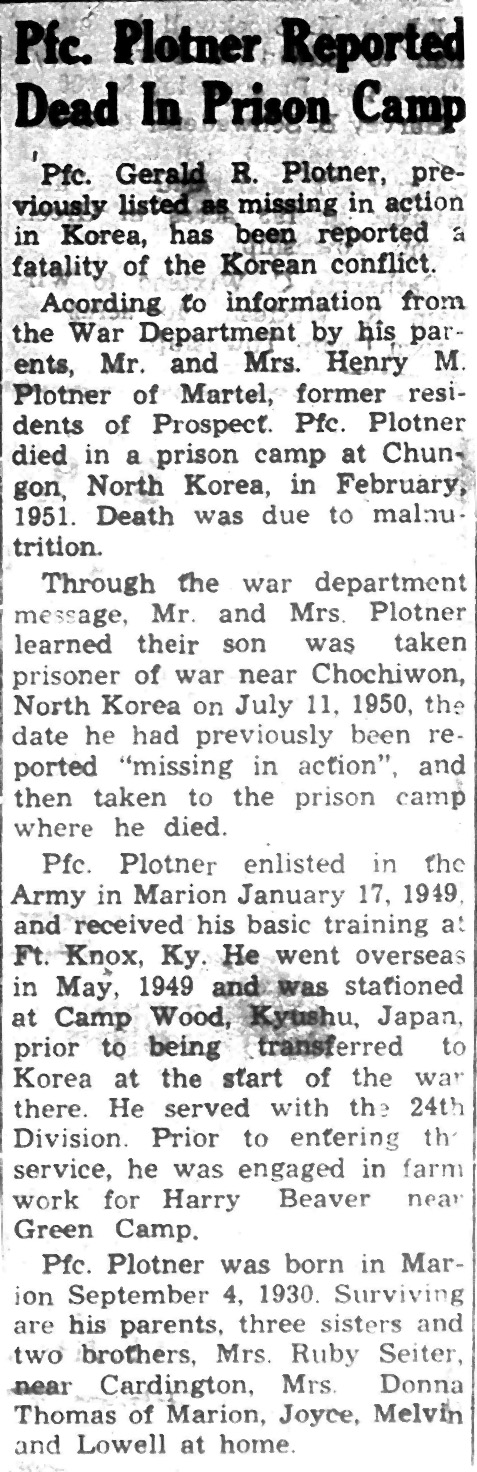
Pfc. Gerald Romain Plotner of the 24th Infantry Division, United States Army was captured while fighting the enemy near Chochiwon, South Korea on 11 July 1950. Plotner was 21 years old at the time of his death. He was part of “Tiger Death March”, in which prisoners were marched 90 miles into North Korea. two-thirds of the 830 men died. Pfc. Gerald R. Plotner died at Hanjang-ni, North Korea on 6 March 1951. Pfc. Plotner’s remains were never recovered as of this writing, February 2019.
Pfc. Gerald R. Plotner was born 4 September 1930 and listed as a resident of Prospect, Ohio. He enlisted in the Army in Marion, Ohio on 17 January 1949.
Pfc. Plotner was a member of Company L, 3rd Battalion, 21st Infantry Regiment, 24th Infantry Division when he was captured.
Since his remains are not recovered he is memorialized at the Honolulu Memorial Courts of the Missing, Court 4, Honolulu, Honolulu County, Hawaii and the Marion Veterans Parks on the Korean Honor Roll.
Private First Class Plotner was awarded:
Combat Infantryman Badge, the Prisoner of War Medal, the Korean Service Medal, the United Nations Service Medal, the National Defense Service Medal, the Korean Presidential Unit Citation and the Republic of Korea War Service Medal.
Service Number: RA15271451
Comments: Private First Class Plotner was a member of Company L, 3rd Battalion, 21st Infantry Regiment, 24th Infantry Division. He was taken Prisoner of War while fighting the enemy near Chochiwon, South Korea on 11 July 1950, forced to march to North Korea in the “Tiger Death March”, and died at Hanjang-ni, North Korea on 6 March 1951. His remains were not recovered.

Plotner

Korean War Project
Hall of Valor
Honolulu Memorial, Court of the Missing

Pfc. Gerald R. Plotner is listed on the Korean Honor Roll, Marion Veterans Parks, on the west side of the Marion County Courthouse.

KIA
Pfc. Paul Earl Terry of the 24th Infantry Division, United States Army was killed in action along the Kum River, South Korea on 14 July 1950. He was 18 years old at the time of his death. He is listed as a Marion County casualty in the Korean War. His last known home of record was in Marengo, Ohio. PFC Terry was born 26 Apr 1932 in Delaware County, Ohio. PFC Paul E. Terry is buried Greenmound Cemetery, Kilbourne, Ohio.
PFC Paul E. Terry was serving with the 63rd Field Artillery Battalion (105mm), Headquarters Battery of the 24th Infantry Division.
Service Number: RA15271471
Born: 26 April 1931
Home or Place Of Enlistment
Marengo, Ohio
Location or Battle Zone: Samgyo-Ri
Burial Location: Greenmound Cemetery, Kilbourne, Oh
Comments: Private First Class Terry was a member of the 63rd Field Artillery Battalion, 24th Infantry Division. He was Killed in Action while fighting the enemy along the Kum River, South Korea on 14 July 1950. Reported DOD last known home of record – Marengo, Ohio.

From the Marion Star dated  July 22, 1950

Marion Youth
Missing In
Korean Action
Pfc. Paul Terry, 18,
May Be With U.S.
Gen. Wm. F. Dean

Pfc. Paul Earl Terry, 18, son of Mr. and Mrs. Arnold Terry of 195 Chicago avenue is “missing in action” in the current Korean campaign.
A member of the 63rd Field Artillery Battalion near Taejon, he is reported missing since July 14. A telegram was received by his parents from the Defense Department Wednesday.
He was a member of a battery command unit. His parents received a letter from him dated July 11 telling them he had been in a battle and he was well and feeling alright.
That was the last communication received concerning their son until the Wednesday telegram.
May Be With Gen. Dean
Mrs.. Terry said her son had written he had served with Major General William F. Dean for a while but they did not know for how long or where.
Ge. Dean, commander of the 24th Division, has also been reported missing in action, according to an Associated Press report.
On July 14, the day Pfc. Terry was reported missing, American ground forces were trying to hold the Red army tanks on the Kum River line. It was that day the first breach of the Kum line amid severe fighting was reported.
Pfc. Terry attended Vernon Junior High school but left school to work for the Marion Steel Building Co. as a laborer.
He enlisted in the army in February 1949 and was sent to Japan in May 1949. He attended school in Japan and was graduated from army training school there.
He has five brothers and three sisters. On brother Frank, is a staff sergeant in the U.S. Army supply corps at Dayton. His other brothers are: Harold, Dale, Vinal and Donald. His sisters are: Mrs. Ervin Jones of Delaware, Esther and Sandra Terry still at home.
“We do so hope he’s alright,” said Mrs. Terry today. We just hope and pray he’ll turn up among some of the wounded.”

Two Articles both about Pfc. Terry and Gen. Wm. Dean

General Wm. Dean Bio

Account of the Walking General. This gives some insight to the action Pfc. Terry may have been part of.

Pfc. Paul Earl Terry is listed on the Korean Honor Roll, Marion Veterans Parks and on the west side of the Marion County Courthouse.

MIA-Remains Identified
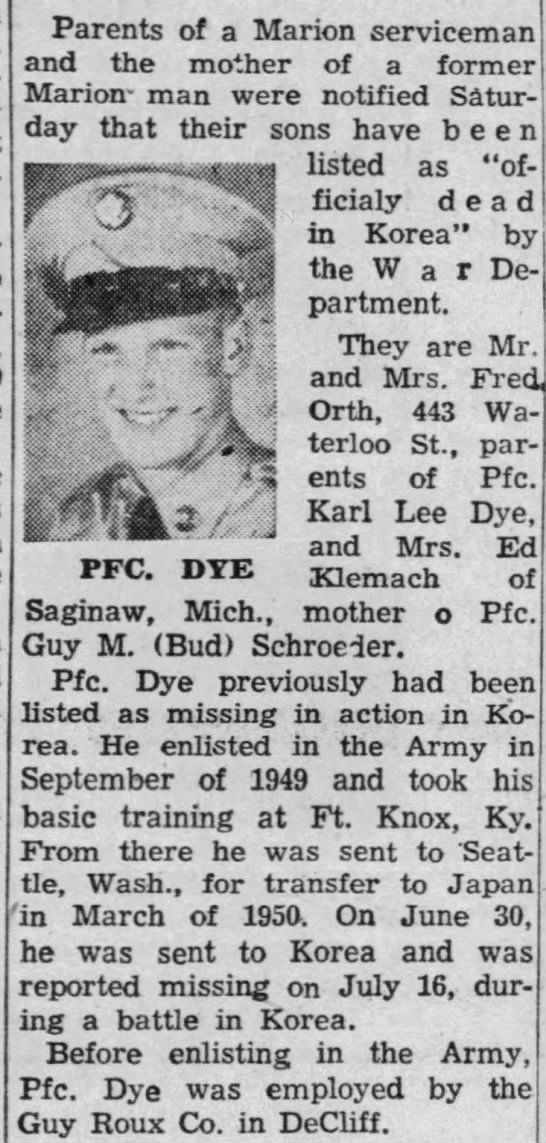
Pfc. Karl Lee Dye of the 24th Infantry Division, United States Army was listed as Missing in Action while fighting the enemy in South Korea on 16 July 1950. He was presumed dead on 31 December 1953.
In July 1950, Dye was a Field Artillery Cannoneer assigned to Battery B, 52nd Field Artillery Battalion, 24th Infantry Division, engaged in combat operations (the Battle of Taejon) against North Korean (Democratic People’s Republic of Korea) forces, near Taejon, South Korea. According to a witness, he was seriously wounded by an enemy mortar shell and placed in an ambulance. The ambulance allegedly encountered an enemy roadblock. Dye was reported Missing in Action on 16 July 1950. Dye is thought to have been 17 years old at the time of his death, nearly a month from his 18 birthday.
Pfc. Dye’s remains were identified and accounted for on 3 December 2018.
Pfc. Dye was born 14 August 1932.

Pfc. Karl L. Dye is memorialized at the Honolulu Memorial Courts of the Missing, Court 4 (Recovered), Honolulu, Honolulu County, Hawaii.

Pfc. Karl L. Dye is listed on the Korean Honor Roll, Marion Veterans Parks and on the west side of the Marion County Courthouse.

Private First Class Dye was Awarded:
Purple Heart, Korean Service Medal, United Nations Service Medal, National Defense Service Medal, Korean Presidential Unit Citation and the Republic of Korea War Service Medal.

Also see the National Korean War Veterans Memorial (Find A Grave Memorial 117686350).

KarlDye

Korean War Remembrance

Honolulu Memorial, Court of Missing

Korean War Veterans Memorial

Honolulu War Memorial

Marion Veterans Parks