Medal of Honor Recipient – William B. Mayes

Medal of Honor Recipient
William B. Mayes

William Brown Mayes was born in Marion (unconfirmed), Ohio, on 11 August 1837. His parents are Joseph & Rebecca (Work) Mayes. William B. Mayes at some point relocated to DeWitt, Iowa. On 25 August 1862, at age 25, he was mustered into Federal service while in the 11th Iowa Infantry, K Company. He was mustered out 2 June 1865, in Washington, D. C. William married Sarah J. (Cowan), on 14 May 1868*. It appears William was an attorney while he lived in Los Angeles, California. William died 16 August 1900, in Los Angeles, California. He is buried in Angelus Rosedale Cemetery, Los Angeles. While serving with the 11th Iowa Infantry he performed such an act of heroism that he was awarded the Medal of Honor.
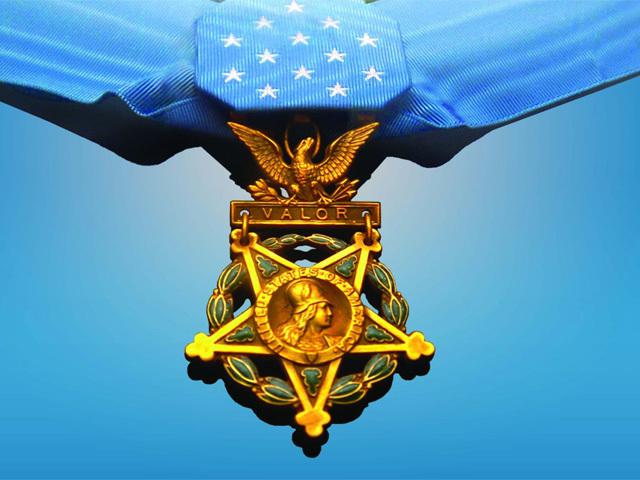
Medal-of-Honor-Main
On 15 June 1864, near Kenesaw Mountain, Georgia, with one companion and under a fierce fire from the enemy at short range, Private William B. Mayes went to the rescue of a wounded comrade who had fallen between the lines and carried him to a place of safety. Private Mayes was at the time serving with K Company of the 11th Iowa Infantry.
His Medal of Honor was issued on 27 November 1899.

Congressional Medal of Honor Society

Hall of Valor Project

Ohio Veterans Hall of Fame

William B. Mayes’ name is not found on any memorials in Marion, Ohio. His name and citation are on the National Medal of Honor Memorial, White River State Park, Indianapolis, Indiana.


*Note:
In Sarah’s obituary it states that she and William Mayes were married by, “Alexander S. Marshall of Marion.” My research found that Mr. Marshall was from Marion, Iowa. I have not found any documents that link William Mayes to Marion, Ohio. It is possible that someone along the lines had made the assumption that he was from Marion, Ohio, due to the fact that his parents had lived in Ohio. It is still very possible that William had been in both Marion, Ohio and Marion, Iowa. U.S., Civil War Soldier Records and Profiles, 1861-1865, states that he was born in Marion, Ohio. I do not know the source that was used in this book, but I have found no “documents” supporting his birth in Marion, Ohio. Many web sites states his birth as Marion, Ohio, but their sources are not known. It must be with caution to not have multiple source documents. None the less his heroic service is recognized on this site.
Research for such documents will be continued.

National Medal of Honor Memorial, White River State Park, Indianapolis, Indiana

Orders Are Sent Out To Recruit To Full Peace-Time Strength

May 9, 1916 Ohio National Guard called to recruit to full Peace time strength.

On May 9, 1916 President Woodrow Wilson called on three border states to ready for service on the border with Mexico. He also prepared regular federal troops for service on the border. This calling out of militia on the border caused the Mexican Minister of War, Alvaro Obregon, to state that he would not enter into any agreement until he discussed further with his government. The state militias ordered to the border were Arizona, New Mexico and Texas. The militias would add about 4,000 men and the Federal men added would number about an additional 3,000. These units were to report to General Frederick (Fighting Fred) Funston for orders.

 General Frederick (Fighting Fred) Funston was born in New Carlisle, Ohio and later awarded the Medal of Honor for service in the Philippine–American War. He died of a heart attack on February 19, 1917 at the age of 51. He was to be considered for command of U.S. forces going to Europe prior to his unexpected and sudden death.

The U.S. Senate voted this day, May 9, 1916, to have a Regular standing Army of 250,000 men and a federal volunteer army plan. Congress then fixed the regular army number at 175,000 men for peace time strength and a 400,000-man militia for defense. This would set the stage for recruitment of the state militias.

The State Department had also begun warning U.S. citizens to return north from Mexico as talks were failing and Mexican President Venustiano Carranza had begun sending Mexican Federal troops to the border to stop further entry of American troops.

On May 18, 1916 Ohio Governor Frank B. Willis, a Delaware, Ohio native, ordered Ohio Adjutant General Benson W. Hough, to bring all Ohio National Guard units to full peace time strength. Recruitment was to bring the Ohio militia to full strength in the event it was needed for service on the border.

Governor Willis ordered, “Commanders are directed, as expeditiously as possible, to secure volunteer lists of desirable men to be used as a basis and nucleus for recruitment to war strength if the same becomes necessary”. General Hough stated, “…this is not to be regarded as a “war scare.”” The General also cited that the War Department had noted Ohio was at 8,004 men and full peace time strength was to be 9,300. He also favored immediate recruiting as it would increase the Ohio National Guard’s chances of being called for border service and it would provide lists sufficient for later formation of additional companies should the need arise.

Life At An Army Outpost on the Mexican U.S. Border

BorderMedal

Marion Daily Star 4-29-1916

An Outpost of
American Army
Trim Brown Tents and Grim
Silence in Mexico.

Mexicans Shoot
for the Pleasure

Americans Conserving Ammunition
in Every Way.

Comment of American Sergeant
in Charge of New American
Type of Army–Mexicans
May Shoot Wrong Way.

By Kent A. Hunter
Columbus, N.M. Apr. 29.
Down at the “South Gate” on the road to Las Palomas, is an outpost of the American Army. Twelve men are there under command of a sergeant, and their trim brown tents, in perfect alignment, show against the skyline of the organ mountains as the teeth of a saw.

In front of the tents are two orderly stacks of rifles, off to one side is the cook tent, with sanitary refuse cans, and a clean oven made of adobe and tin.A typical Remington background is the picked line, some twenty-five yards to the rear of the tents, where the horses of the men lazily kick at each other and chew their hay.
Fifty yards beyond the little American camp is a tumbledown, rickety shack. Around it, in nondescript, ragged and ill-fitting uniforms, lounge some forty Mexicans. One, a little less dirty than the others, is an authority.
The contrast between the American and Carranza armies is clearly shown by two little outposts.
On the Mexicans’ side of the line there is indiscriminate shooting, at crows, at prairie dogs and even at tin cans and bunches of soap weed. On the American side there is a grim silence, as if the men in khaki cherished every shot in their pouches.
On the Mexican side there is abundance of Tequila. Much of the shooting may be attributed to the repeated drafts of the Mexican liquor. Where the American tents are pitched there is a big water can, but no evidence of other liquor.
New American Army
The sergeant in charge is of the new type of the American army. He isn’t more than twenty-six or seven. He is clean shaven, and his hair is close cropped. A short, bristly, typically Broadway mustache is to be noted. He has been on the line since 1913, and has seen much of the antics of Mexican armies.
“Some day,” mused the sergeant, “some of those crazy Mexicans are going to do a little of their shooting this way. Then maybe we can use these.” He pointed to the stacked rifles, slapped the 45 caliber automatic pistol at his side, and ran an appraising finger along the edge of a shiny bayonet that slid on oiled catch bolts from its leather case.
“You know,” he continued, “some of us have been down here for three years. We’ve been shot at by the Mexicans. We’ve had to sit by and pretend not to understand when they shouted their vile words at us, and {unreadable} up with the ‘Muertos a Los {unreadable}, (Death to the Americans) Until the boys of Pershing went through that gate, ten thousand strong, we had to stand it, and like it.
But now things are different. We can go shot for shot with ’em and I don’t know but what we’d do a little more than even trading. Only now, they don’t cuss at us, and they are very careful, to do their shooting toward the interior of Mexico.”
All around the American lines are little holes in the ground, with the spare earth thrown up on the south end.
Trenches says the sergeant in reply to a look of inquiry. One of them is just back of the cook tent. It is about a foot deep, six or seven feet long, and maybe two feet wide. At the south end is a fire log, and on each of the flanking side is another log. The cook showed, just for the fun of it, how he can land in his trench by one flying leap from the back of the cook tent.
The picture recalls the old flag of Massachusetts, with it’s motto: “Don’t Tread on Me.”

LifeAtAnArmyOutpost “NewsArticle”

Border Campaign (Border War with Mexico) 1910-1919 Company D, 4th Infantry Regiment, Ohio National Guard’s Involvement

In 1910 revolution begins to occur in Mexico. This soon causes battles to occur near the Mexico-United States borders. American forces are deployed along the southern border to protect American citizens and to ensure fighting stays on the Mexican side of the border.
Due to raids coming across the border onto the American side, more troops are garrisoned near border towns. In 1914 General John J. Pershing meets with rebel Poncho Villa at Fort Bliss Texas to negotiate for peace on the border.
On April 9, 1914 the Tampico Affair occurred, which resulted in President Woodrow Wilson ordering the U.S. Navy to invade the port of Veracruz. The Navy claimed victory in the invasion.
Pancho Villa and his band of followers, the Villistas, fight with American troops along the border. He also organizes and leads several raids into towns and villages in the United States. In March of 1916 Villa raids the town of Columbus, New Mexico. Here the American forces greatly weaken Villas forces. This prompted President Wilson to order General Pershing to pursue Villa and his forces into Mexico to capture or kill Villa.
Due to the continuing raids President Woodrow Wilson orders the National Guard to the border to assist the Federal troops. An estimated 117,000 guardsmen were garrisoned along the border of Mexico in Texas, New Mexico, Arizona and California.
The news was daily reporting of the activity along the border, the negotiations between Washington and Mexico City, and of the War raging in Europe. One day there was talk of peace with Mexico, then a few days later of impending war with Mexico. After President Wilson called for the National Guard to mobilize for Federal Service, the news reported that the National Guard may not be needed. Again, days later regiments were on their way south to the border. Then reports were made that troops may return. This must have caused great confusion for the families of the guardsmen awaiting orders to move to the border. News continued to change until finally in August of 1916, Company D of Marion was en-route with the 4th Infantry to the border.
I will share some of the news articles that I found. Since some are difficult to read. I will retype them as best as I can for easier reading.

National Guard Mobilized (Border Campaign) 1 of 2

National Guard Mobilized (Border Campaign) 2 of 2


Marion Soldiers of the Rainbow Division

Prior to World War I Marion, Ohio, was home to a company of the Ohio National Guard. This Company was Company G of the Fourth Regiment of the Ohio National Guard during the War with Spain. Company G later was reorganized as Company D, Fourth Regiment, Ohio National Guard. Company D was activated into Federal service in 1916 to serve on the Mexican border. Shortly after being mustered out of Federal service and returning back to Marion, Ohio; the unit was again called into Federal service to serve in the Great War (World War I).

The information I will share is not a complete history. I only wish to share the information I find with others who are interested in local and military history.  I will try to provide links to other sites with more in depth history on subjects that I will only touch on briefly. What will follow is information on the unit’s return from the Mexican border through it’s return from Europe.